

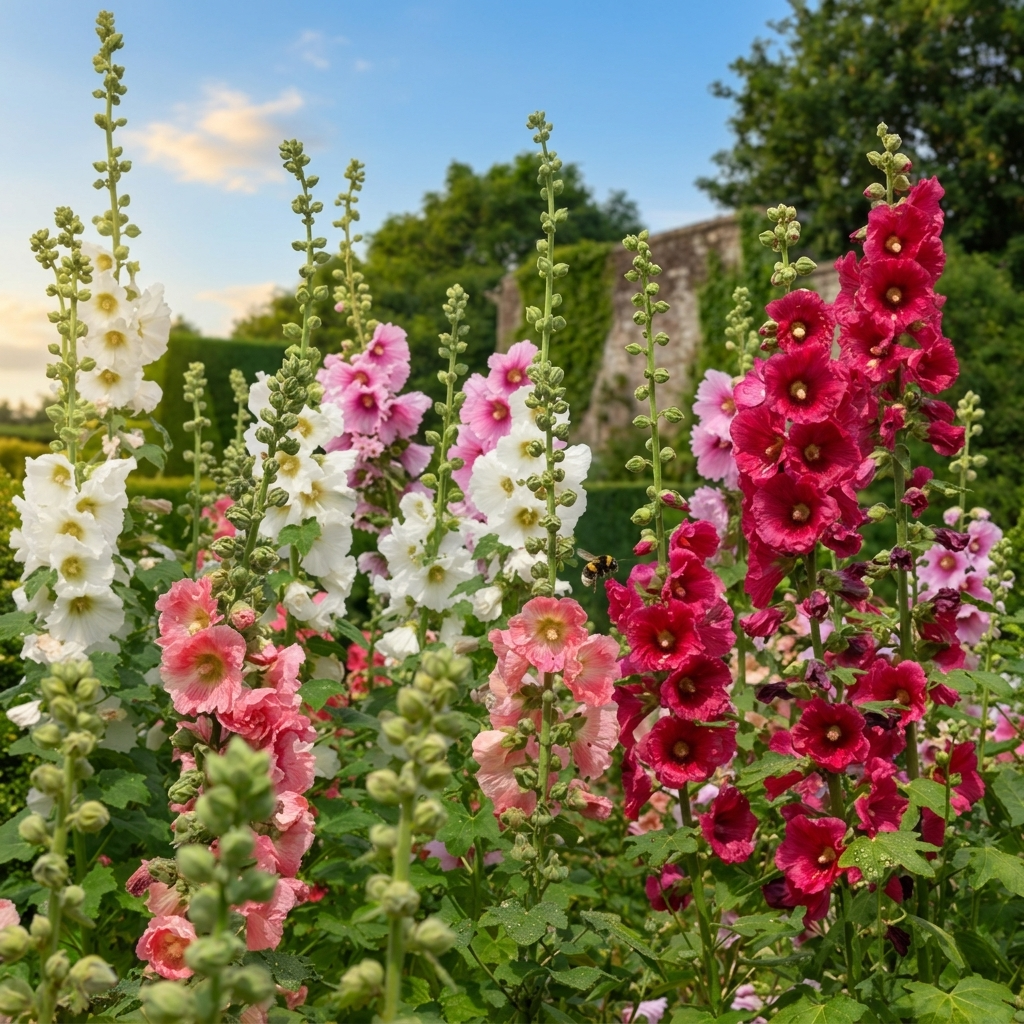
From a Leafy Rosette to Towers of Summer Flowers
A friendly guide to sowing, growing and enjoying hollyhocks in Hungary.
Come Into the Garden With Me…
Today, we're growing hollyhocks - the flowers that make a garden look as though it has been there for generations.
They are tall, unmistakable and wonderfully old-fashioned. Put them beside a fence, against a sunny wall or behind a cottage border and suddenly the garden gains height, rhythm and a little romance.
But hollyhocks also teach us patience. Some grow leaves in their first year and flower in the second. Others have been selected to flower much faster, sometimes in the first season if we sow early enough. That difference matters, and we'll make it simple.
1. Meet the Hollyhock
The classic garden hollyhock is Alcea rosea. It forms a low rosette of rounded leaves, then sends up strong flowering stems carrying bloom after bloom from the bottom upward.
Flowers may be single, semi-double or fully double, in white, cream, yellow, apricot, pink, red, purple and almost-black shades. Some plants reach only around 80 cm; traditional forms can rise well above two metres.
Hollyhocks are often described as biennials or short-lived perennials. In practice, many behave according to variety, sowing time, winter conditions and whether we let them set seed.
|
GOOD TO KNOW |
2. Finding the Right Place
Sunshine
Give hollyhocks plenty of sun. They can tolerate a little light shade, but the strongest stems and best flowering usually come from a bright, open position.
A wall, fence or open border?
Tall varieties are perfect against a fence, shed, facade or at the back of a border. The structure gives visual support and can also make staking easier. Shorter varieties such as Majorette Champagne can sit much closer to the front.
Soil
Hollyhocks like reasonably fertile, moisture-retentive soil that still drains well. They dislike being waterlogged, but they are also not at their best if the soil becomes bone dry for weeks while flower stems are developing.
In a Hungarian summer, mulch around established plants can help keep the root zone cooler and reduce moisture loss. Leave the crown itself open rather than burying it under a wet blanket of mulch.
Airflow matters
This plant has one famous weakness: hollyhock rust. Good spacing, sunlight and moving air will not guarantee perfect leaves, but they make life harder for disease and easier for us.
|
A COMMON MISTAKE |
3. The Hollyhocks We Grow With You
Holland Kertészet currently offers five hollyhocks, and they give us a very useful range from compact first-season colour to traditional second-year giants.
Chater's Mixed
A classic mixed double hollyhock, about 180 cm tall. Sow in a seedbed from May to July, plant out in October or November, and expect the main flowering display in the second year.
Chater's Deep Purple
For drama, this is the one. Deep purple double flowers on stems around 180-250 cm tall. It follows the same biennial rhythm: sow May-July, plant out in autumn, flower the following year.
Majorette Champagne
Much shorter at around 80 cm and sold for annual flowering. It can be started indoors in February-March or raised outside in a seedbed in May-June. A lovely choice where a two-metre plant would simply be too much.
Summer Carnival
Around 140 cm tall, with many flowers along each stem. It can be started early indoors or sown in a seedbed in late spring, and is sold as a first-season flowering type. The product listing also notes that the flowers are edible; only use flowers for food when you are certain the plants have been grown without unsuitable treatments.
Antwerp Stars
A colourful mixture around 150 cm tall, also offered as a faster annual-flowering type. Good for fences, cutting and a more informal mix of colours.
|
GROW WITH US |
4. Let's Sow
The traditional biennial route
For Chater's types, sow from May to July in a nursery bed or pots. Keep the seedbed evenly moist while seedlings establish. Once the young plants are sturdy, move them to their permanent position in October or November.
They will spend winter as leafy plants, then use the following spring to build those tall flowering stems.
The faster route
Majorette Champagne, Summer Carnival and Antwerp Stars can be started indoors in February-March if you want to encourage first-season flowering. Give seedlings warmth, excellent light and enough time to develop before planting out after frost danger has passed.
Sowing depth
Cover hollyhock seed lightly rather than burying it deeply. Keep the compost moist but not saturated while germination begins.
Give seedlings room
Hollyhocks make substantial plants. Pot on crowded seedlings before roots become tangled, and do not judge final spacing by the tiny plant in your hand today.
|
DON'T PANIC |
5. From Rosette to Flower Tower
Watering
Water young plants regularly while roots establish. Mature hollyhocks are reasonably robust, but prolonged Hungarian drought during stem extension and flowering can reduce bloom quality and leave plants stressed.
Water at soil level when possible rather than soaking the foliage. That simple habit is useful when rust is a concern.
Feeding
A modest spring feed or compost is usually enough in ordinary garden soil. Too much nitrogen can produce lush leaves and soft stems rather than the sturdy flowering structure we want.
Supporting tall plants
A 200 cm hollyhock full of flowers catches wind. In exposed gardens, stake tall stems before they begin leaning. A cane or discreet support tied loosely is much easier than rescuing a stem after a thunderstorm.
Remove lower damaged leaves
As the season progresses, older lower leaves may become marked or tired. Removing badly affected foliage improves appearance and airflow, especially if rust appears.
|
WHAT I WOULD DO |
6. Flowers - and Hollyhock Rust
Then the first buds open. A hollyhock stem often begins flowering low down and continues upward, so the display develops gradually rather than arriving all at once.
The famous problem: rust
Hollyhock rust usually shows as yellowish spots on the upper leaf surface and orange-brown pustules underneath. It can make leaves unattractive long before flowering has finished.
Start with hygiene: remove badly infected leaves, do not leave diseased debris around the plant, water the soil rather than the foliage, and avoid crowding. At the end of the season, clear infected material rather than composting it in a home heap that may not become hot enough to destroy disease spores.
Slugs and snails
Young rosettes can attract slugs and snails, especially in damp spring weather. Check seedlings early; a mature hollyhock can lose a leaf, but a tiny plant has much less to spare.
Aphids
Tender tips and flower buds may attract aphids. Small colonies are much easier to manage than large ones, so inspect stems during your normal garden walk.
|
GOOD TO KNOW |
7. Cutting, Deadheading and More Flowers
Can we cut hollyhocks for the vase?
Yes. The Holland Kertészet listings specifically recommend several varieties as cut flowers. Choose a strong stem when the lowest flowers are open and upper buds are still waiting.
Use clean secateurs and place stems into clean water promptly. Because hollyhock stems are large, they work best in generous arrangements rather than delicate little vases.
Deadhead or save seed?
If you remove faded flowers, the plant stays tidier and may continue directing energy into the remaining buds. But if you want seed, leave some pods to mature fully.
Let them self-seed
Hollyhocks are wonderful garden wanderers. If you let seed fall, new seedlings may appear near the parent plant. They may not be identical to the original, especially from mixed or hybrid strains, but that unpredictability suits a cottage garden beautifully.
A note on edible flowers
Summer Carnival is sold with edible flowers noted on the packet. If you choose to use flowers as food, grow them specifically for that purpose, identify the plant confidently, and do not use flowers treated with products not approved for edible crops.
|
TRY THIS |
8. When Summer Ends
After flowering
Once a stem has finished and you do not need seed from it, cut it back. This reduces untidy growth and removes another place where rust can persist.
Will the plant return?
Traditional hollyhocks may survive beyond their second year, but they are best treated as biennials or short-lived perennials rather than permanent shrubs. Keep younger plants coming along and you will never be dependent on one old crown.
Saving seed
Allow selected seed pods to become dry and brown on the plant. Collect them on a dry day, open them over paper, and let the seed finish drying before storing it somewhere cool and dry.
Label the variety and year. Mixed hollyhocks may surprise you, and plants grown near other colours can produce seedlings that do not look exactly like either parent.
9. Building a Hollyhock Rhythm
The easiest way to have hollyhocks every year is to overlap generations. Sow some traditional biennials each summer while older plants are flowering. Add faster first-season strains when you want immediate colour.
That way, there is always another rosette waiting in the wings.
|
A LOVELY GARDEN HABIT |
Your Hollyhock Cheat Sheet
• Holland Kertészet currently offers Chater's Mixed, Chater's Deep Purple, Majorette Champagne, Summer Carnival and Antwerp Stars.
• Choose the variety by final height: roughly 80 cm to 250 cm across the current range.
• Traditional Chater's types are biennial: sow May-July, plant out October-November, flower in year two.
• Majorette Champagne, Summer Carnival and Antwerp Stars are offered as faster first-season flowering types.
• Give hollyhocks plenty of sun and reasonably fertile, well-drained soil.
• Support tall stems in windy gardens before they lean.
• Water at soil level and give plants space to reduce rust pressure.
• Remove badly rusted leaves and clear diseased debris at season's end.
• Cut stems for the vase when lower flowers are open and upper buds remain.
• Keep new plants coming so older short-lived plants can be replaced naturally.
If You Remember Only Five Things…
1. First choose whether you want a traditional second-year hollyhock or a faster first-season type.
2. Give tall varieties sun, room and support.
3. Rust is the main problem: airflow, clean-up and soil-level watering matter.
4. Do not panic when a biennial spends its first year making leaves.
5. Let a few plants make seed - hollyhocks are at their best when generations overlap.
One Last Walk Around the Garden
We began with a flat brown seed and, depending on the variety, perhaps a little patience.
First came the rosette. Then the stem began rising. One metre. One and a half. Perhaps two. And suddenly flowers were opening all the way up a wall that had looked rather ordinary a year before.
That is what hollyhocks do so well. They don't simply add colour. They give the garden height, history and presence.
And once you understand the rhythm - which varieties flower quickly, which wait until their second year, how to manage rust and when to save seed - they stop feeling mysterious.
Soon you'll have young rosettes waiting, tall stems flowering and a few self-sown surprises appearing exactly where the garden wants them.
When you're ready for the next plant…


