

From Tiny Seeds to a Wall of Summer Trumpets
A friendly guide to sowing, growing and enjoying Morning Glory in Hungary.
Come Into the Garden With Me…
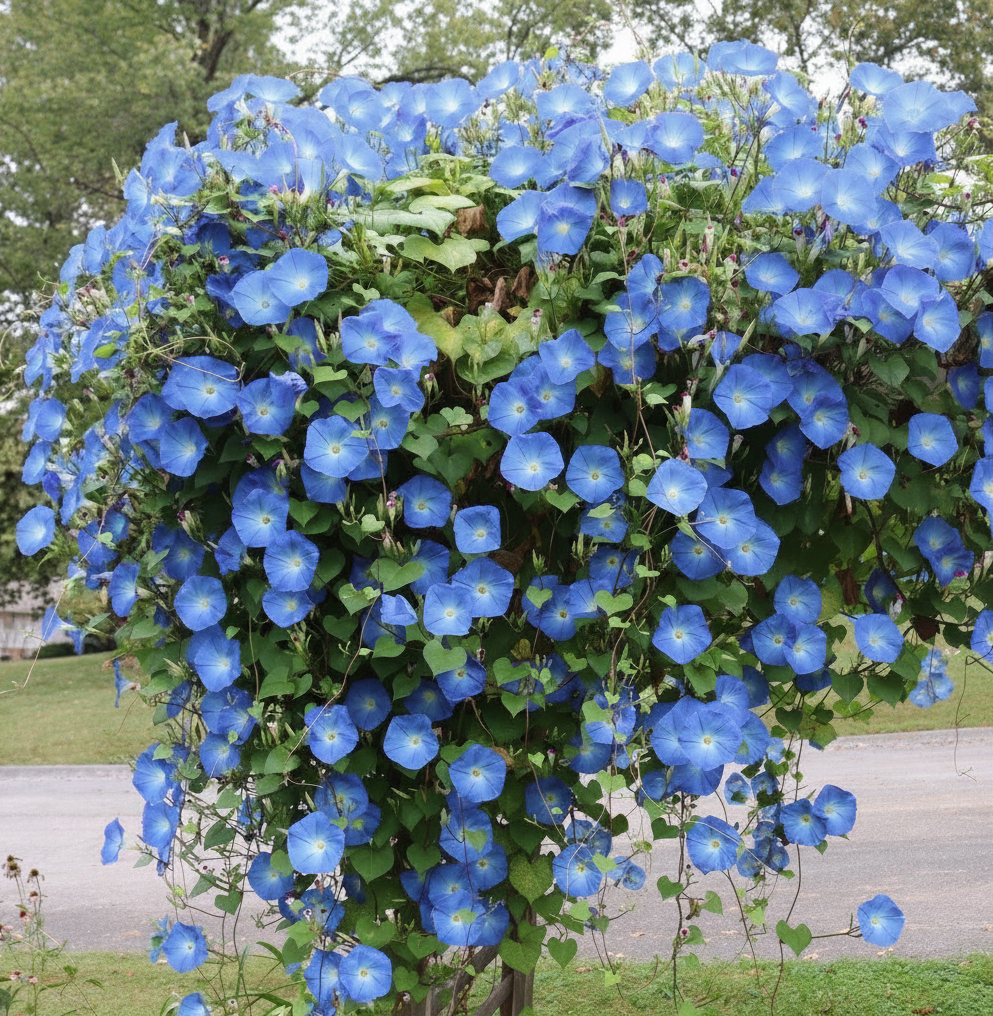
Today, we're growing Morning Glory - one of the fastest ways I know to turn something ordinary into something wonderfully alive.
A bare fence. A wire panel. A balcony railing. An old wall you would rather not look at. Give Morning Glory a little support, some sunshine and a warm summer, and within weeks those plain surfaces can disappear beneath heart-shaped leaves and trumpet flowers.
The flowers are famous for opening with the morning light. On a warm Hungarian summer morning, the vine can be full of fresh blooms before breakfast, each one looking as though it was painted overnight. By afternoon some may already be fading, only for new buds to open the following day.
Morning Glory is an annual climber in our climate. That means we sow it in spring, watch it race upward through summer, enjoy flowers from midsummer into autumn, and then begin again the following year. It sounds temporary, but the amount of growth one small seed can produce is astonishing.
In the Holland Kerteszet range we grow several forms with you, including Morning Glory Pink, Venice Pink and Cardinal Climber. They are not identical, but they share the same useful habit: fast vertical growth and flowers that make sunny structures far more interesting.
This is a perfect beginner plant if you want drama without waiting years. The trick is not complicated care. The trick is giving the plant warmth, a climbing support from the beginning, enough water while it is racing upward, and enough sunshine to keep the flowers coming.
So we will start with the seed, help the first little vine find its support, follow it through a hot Hungarian summer, learn what to do when it produces more leaves than flowers, and finally collect a few seeds for next year.
Ready? Let's grow a wall of flowers.
1. Meet Morning Glory
Morning Glory is the common name used for several ornamental plants in the genus Ipomoea, part of the bindweed family, Convolvulaceae.
The classic garden forms are vigorous annual climbers with twining stems. Rather than gripping a wall with suckers or tendrils, the stem itself winds around a support as it grows. Give it string, wire, a trellis or a thin pole and it knows exactly what to do.
The leaves are usually soft green and often heart-shaped. The flowers are funnel- or trumpet-shaped and can be pink, blue, purple, white, striped or combinations of these colours.
The name Morning Glory comes from the flowering rhythm. Many blooms open early in the day and fade later, especially in hot sunshine. Do not worry about the short life of one flower. A healthy vine produces buds continuously, so the display renews itself day after day.
How big does it get?
Depending on variety and growing conditions, Morning Glory can climb roughly 2 to 4 metres in one season, sometimes more where summer is long and warm. This is why it is much more useful on a fence or trellis than squeezed into the front of a flower bed.
Annual in Hungary
Morning Glory is frost tender. In Hungary we grow it as an annual: sow after winter, enjoy it through summer and autumn, then let frost finish the season. Saving seed makes it very easy to start again next spring.
|
GOOD TO KNOW Morning Glory climbs by twining. A smooth, solid wall gives it nothing to hold. Add strings, netting, wire or a trellis first and the plant will do the rest. |
2. The Morning Glories We Grow With You
At Holland Kerteszet, Morning Glory appears in several forms. This book teaches the shared growing method, but it is worth knowing what each packet contributes to the garden.
Morning Glory - Pink
• A Buzzy variety with clear pink trumpet-shaped flowers.
• Fast-growing and particularly useful for fences, trellises and balconies.
• The packet recommends sowing from April to June.
• Flowering is expected from July into October.
• Best in full sun and well-drained soil.
Morning Glory - Venice Pink
Venice Pink gives the same quick climbing effect with a more decorative pink-flowered look. Grow it exactly where you want a soft, romantic screen: over a trellis, along a sunny fence or up strings on a balcony.
Morning Glory - Cardinal Climber
Cardinal Climber brings a different character to the group, with finer foliage and vivid flowers. It is especially attractive where you want a lighter, more delicate climbing effect rather than a dense wall of broad leaves.
|
GROW WITH US If you have room, sow two different Morning Glories on separate supports. You will quickly see how much leaf shape, flower colour and growth habit can vary inside one familiar garden name. |
3. Finding the Perfect Place
Morning Glory is not shy. It wants sun, warmth and something to climb.
Full sun for the best flowers
Choose a position with at least six hours of direct sunlight. Morning Glory will make leaves in lighter shade, but flowering is usually far better in full sun.
Think vertically before you sow
• A wire fence is almost perfect because the stems can wind around it naturally.
• A wooden fence works well if you add vertical strings or netting.
• A pergola post needs twine or wire unless it is narrow enough for the vine to circle.
• Balcony railings can work beautifully if the plant cannot trail into neighbouring spaces or block access.
• Large obelisks and wigwams give Morning Glory a freestanding structure in a flower bed.
Shelter from strong wind
The leaves are soft and the long stems can be damaged by repeated strong wind. A sunny but reasonably sheltered position gives a neater plant and prevents the support from becoming a sail during summer storms.
|
A COMMON MISTAKE Planting first and planning the support later. Morning Glory grows surprisingly fast. Put the support in place before or at planting so you do not have to untangle a metre of vine from the wrong neighbour. |
4. Let's Sow
Morning Glory seed is large enough to handle easily, which makes this a friendly plant for beginners.
When to sow in Hungary
For the Pink variety in our range, the packet window is April to June. You can start a little earlier under warm protection, but do not rush tender seedlings into cold soil. Morning Glory genuinely prefers warmth.
Soaking the seed - optional, but useful
The seed coat is firm. Soaking seeds in lukewarm water for several hours or overnight can help moisture reach the embryo more quickly. Do not leave them soaking for days; the aim is to soften the coat, not ferment the seed.
Sowing in pots
• Fill small pots with seed compost and water before sowing.
• Place one or two seeds in each pot.
• Cover with around 1 cm of compost.
• Keep warm and evenly moist.
• Move seedlings into very bright light as soon as they emerge.
• Add a small stick early if the seedling begins searching for something to climb.
Direct sowing
Once soil is warm and frost danger has passed, Morning Glory can also be sown directly beside its final support. This avoids root disturbance and often produces very strong plants in May and June.
|
TRY THIS Sow one small batch in pots and another directly outside two or three weeks later. It spreads your risk and shows you which method works best in your garden. |
5. The First Tiny Vine
Morning Glory seedlings are not shy for long. Once the first true leaves appear, growth can accelerate quickly.
Give light immediately
Poor light produces long, weak seedlings that stretch before they have enough strength to support themselves. Give them the brightest safe position you have.
Do not overpot too early
Morning Glory dislikes unnecessary root disturbance. If you start in individual pots, you can often move the whole root ball directly into the garden without repeated pricking out.
Teach it where to climb
Once the stem is long enough, gently guide it onto a small stick or string. Do not tie tightly. Usually one or two gentle turns around the support are enough; after that, the plant understands the assignment.
|
DON’T PANIC A young Morning Glory that seems quiet for a week may suddenly grow several centimetres a day once the weather warms. Warm soil changes everything with this plant. |
6. Moving Into the Garden
Morning Glory hates frost, so patience pays. Planting a little later into genuinely warm conditions usually gives a better result than forcing tender seedlings outdoors too early.
Harden off
• Put plants outside for a few hours on a mild day.
• Start in a sheltered place rather than hot midday sun.
• Increase the time outside gradually for about a week.
• Bring them back under protection if nights turn cold.
• Plant when the weather feels properly settled.
Plant beside the support
Position the root ball 10 to 20 cm from the fence, trellis or string system rather than directly against a wall where the soil may be dry and poor. Angle the first stem gently toward the support.
Spacing
For a dense screen, roughly 20 to 30 cm between plants works well. Give slightly more room if you want individual vines to remain visible rather than becoming one solid mass.
|
HUNGARIAN SPRING NOTE A warm April afternoon can feel like summer, but a late cold night can still stop a Morning Glory completely. May is often the more forgiving month for planting tender climbers outdoors. |
7. The Great Summer Climb
This is the stage when Morning Glory earns its name as a fast climber. Once roots are established and nights are warm, the vine can cover surprising distances in a very short time.
Water deeply
• Keep newly planted vines evenly moist while they establish.
• During hot Hungarian weather, water deeply rather than giving a shallow daily splash.
• Mulch around the root zone to slow evaporation, but leave a little space around the stem.
• Containers and balcony boxes may need checking every day during a heatwave.
Feed, but do not overfeed
Too much nitrogen can give you a magnificent wall of leaves and disappointingly few flowers. If your soil is reasonably fertile, keep feeding moderate. In containers, a balanced flowering feed is more useful than a high-nitrogen leafy-growth feed.
Redirect runaway stems
Morning Glory will happily climb through roses, shrubs and gutters if allowed. Check the plant once or twice a week and redirect stems before they reach places where they become awkward.
|
THE FIVE-MINUTE JOB Every few days, walk along the support and tuck wandering stems back where you want them. Five minutes now is easier than untangling two metres of vine in August. |
8. And Then One Morning…
There is a trumpet flower.
It may be pink, striped, crimson or another shade depending on the variety, but the effect is the same: a smooth bud unfurls in the early light into a flower that looks almost too perfect to be real.
Why flowers close
Morning Glory flowers are often at their best in the morning. Heat and strong afternoon sun speed their decline, so individual blooms may not last all day. This is normal, not a sign that the plant is unhappy.
The daily rhythm
A mature vine can carry dozens of buds at different stages. One flower closes while another opens the next morning. The display is not about one long-lasting bloom; it is about constant renewal.
|
TRY THIS Take your coffee into the garden before the day gets hot. Morning Glory is one of those plants that rewards people who actually see the garden in the morning. |
9. Morning Glory in Pots and on Balconies
Morning Glory is very suitable for containers if the pot is large enough and the support is secure.
• Use a deep container with generous drainage holes.
• Give each plant enough root space; tiny decorative pots dry far too quickly.
• Add a trellis, strings or wires before the plant becomes large.
• Choose full sun where possible.
• Water thoroughly during heat and check the compost daily in exposed positions.
• Make sure the climbing structure cannot topple in wind.
Creating a privacy screen
A row of Morning Glory grown up vertical strings can create a surprisingly effective seasonal screen on a sunny balcony. It is much lighter than a permanent hedge and disappears completely after frost, which can be useful where winter light is welcome.
|
BALCONY NOTE Do not let vines reach gutters, awnings, satellite dishes or a neighbour's balcony. Morning Glory has no sense of property boundaries. |
10. Designing With Morning Glory
Morning Glory is best treated as temporary architecture. Use it where you need height, cover or softness for one season.
For an old fence
Stretch vertical strings or light mesh across the surface and plant along the base. By midsummer the fence can almost disappear.
For a cottage garden
Let Morning Glory climb a simple wooden obelisk behind cosmos, marigolds, zinnias and other annual flowers. The broad leaves form a green backdrop while the trumpets appear above the border.
For a romantic pink scheme
Use Pink or Venice Pink with pale cosmos, pink zinnias, white alyssum and soft ornamental grasses. The climbing flowers add height without needing a permanent woody plant.
For contrast
Cardinal Climber works beautifully among plants with larger, rounder leaves and flowers because its finer foliage creates a completely different texture.
|
DESIGN IDEA Use Morning Glory to solve one ugly view rather than scattering it everywhere. A single well-covered trellis can transform the whole feeling of a small garden. |
11. Problems - and How to Solve Them
Lots of leaves, hardly any flowers
The usual suspects are too much shade or too much nitrogen. Move container plants into more sun if possible and reduce high-nitrogen feeding.
Yellowing leaves
Check the soil before adding water. Both drought and waterlogged roots can cause yellowing. In containers, make sure drainage holes are open and the pot is not sitting permanently in a saucer of water.
Aphids
Tender tips can attract aphids. Small colonies can often be washed away with water or left for ladybirds, hoverfly larvae and other natural predators.
Spider mites in hot, dry positions
Very hot, sheltered balcony conditions can encourage spider mites. Look for fine stippling on leaves and webbing. Improve airflow, avoid letting the plant become repeatedly drought-stressed and remove badly affected foliage.
The vine will not climb
Check the support. Thick flat boards and smooth walls are difficult for a twining stem. Add string, wire or mesh and guide the first shoots onto it.
|
A COMMON MISTAKE Assuming a fast-growing vine needs constant fertiliser. Morning Glory already knows how to grow. Too much feeding can turn your flower screen into a leaf screen. |
12. Morning Glory Through the Hungarian Seasons
March-April
Prepare supports and containers. Start a few seeds under warm protection if you want an early beginning, but keep them bright and frost-free.
April-June
This is the main sowing window for the Pink packet in our range. Direct sow once soil is warm, or plant hardened seedlings when frost risk has passed.
June
Growth accelerates. Guide the first stems, mulch the roots and begin deep watering during dry periods.
July-August
The main display begins. Flowers open in the morning and the vines race across supports. Watch watering carefully during heatwaves.
September-October
Flowering can continue until cold weather. Allow selected flowers to form mature seed capsules if you want to collect seed for next year.
First frost
The foliage collapses quickly after frost. Remove the old vines from supports, compost healthy material and store collected seed somewhere dry and labelled.
|
THE RHYTHM OF THE PLANT Morning Glory is a one-season transformation: sow in spring, climb in early summer, flower through high summer and autumn, then clear the support and begin again next year. |
13. Saving Seed for Next Year
Morning Glory makes seed saving wonderfully visible. After a flower fades, a small round seed capsule develops where the bloom was attached.
When to collect
Wait until the capsule is dry and brown. If you pick it green, the seeds inside may not have matured properly.
How to store
• Open the dry capsule over a plate or sheet of paper.
• Remove the dark, hard seeds.
• Let them dry for a few more days indoors if necessary.
• Store in a labelled paper envelope in a cool, dry, dark place.
• Write the variety and year on the packet.
If several Morning Glory varieties flower close together, saved seedlings may not come back exactly like the parent. That can be disappointing if you want absolute uniformity, or rather exciting if you enjoy surprises.
|
SEED-SAVING NOTE Morning Glory seeds should not be eaten. Keep seed packets and collected seed away from children and pets, and use them only for sowing ornamental plants. |
14. Your Morning Glory Cheat Sheet
• Choose full sun.
• Put the climbing support in place before the vine gets large.
• Sow from spring into early summer once warmth arrives.
• Soaking seed for several hours can help soften the hard coat.
• Keep seedlings bright and warm.
• Harden off before planting outside.
• Plant beside strings, wire, trellis or mesh.
• Water deeply during hot, dry weather.
• Feed moderately - too much nitrogen means more leaves, fewer flowers.
• Redirect stems before they reach gutters and shrubs.
• Enjoy flowers in the morning.
• Collect dry seed capsules before frost if you want seed for next year.
|
IF YOU REMEMBER ONLY FIVE THINGS Warmth. Full sun. A support from day one. Deep watering in summer. Do not overfeed. |
15. One Last Walk Around the Garden
We began with a hard little seed and a bare support. Then came the first heart-shaped leaf, the searching stem, the first turn around a string and the sudden summer rush upward.
Before long, the fence was green. Then one morning a trumpet opened. After that there seemed to be another every day.
That is what makes Morning Glory such a satisfying beginner flower. You do not need years to see the result. You can watch the whole transformation in a single season.
Now you know when to sow it, how to help it climb, why sunshine matters, how to water it through Hungarian heat, what to do when leaves outnumber flowers, how to use it on a balcony or fence, and how to save a few seeds for next spring.
Your garden will teach you the rest: which fence warms first in May, where the morning flowers stay open longest, which colour catches your eye from the kitchen window, and how much vine one tiny seed can really make.
Until then, enjoy the mornings. And whenever you're ready to grow something new…
Come into the garden with me.


