

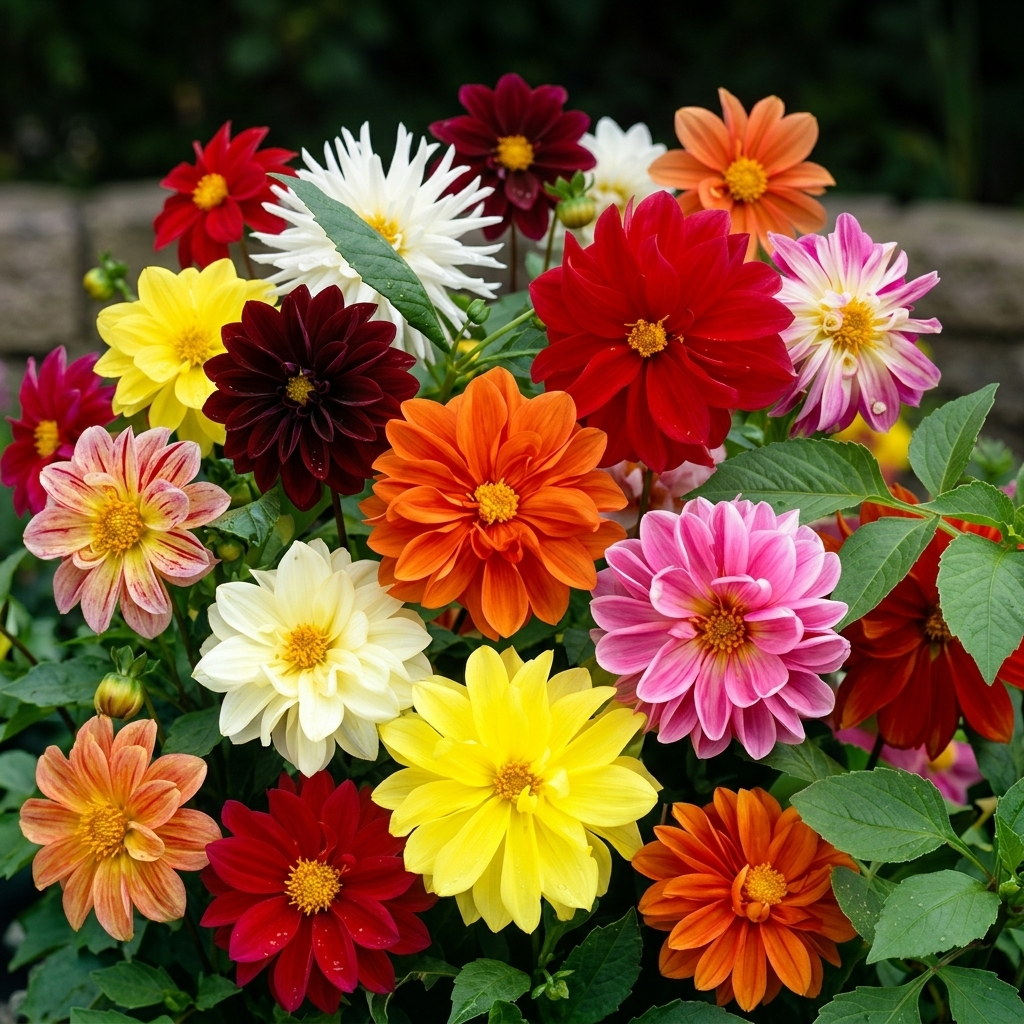
From a Packet of Seeds to a Garden Full of Dahlias
A friendly guide to sowing, growing, cutting and enjoying Unwin's Hybrids dahlias in Hungary.
Come Into the Garden With Me…
Today, we're growing dahlias - but perhaps not in the way you expect.
When most of us hear the word dahlia, we picture a fat tuber being planted in spring. Unwin's Hybrids gives us a different beginning: a small packet of seeds, each one capable of becoming its own slightly different dahlia plant.
That is part of the fun. One seed may give you a warm orange flower, another a rich red, another yellow or pink. Many blooms are semi-double or double, and because this is a mixture, the whole bed develops its own personality as summer goes on.
For gardeners in Hungary, this is a wonderfully practical way to grow dahlias. Start the seeds in spring, protect the young plants from frost, then let them race through our warm summer and flower until autumn cold finally stops them.
Unwin's Hybrids is also much more compact than the enormous exhibition dahlias you may have seen. At around 50-60 cm tall, it fits easily into borders, cutting patches and larger containers without becoming a staking project of heroic proportions.
We'll go from sowing and pricking out to pinching, watering, feeding, cutting flowers, dealing with slugs and heat, and finally deciding whether to save seed, lift the little tubers that form, or simply begin again next spring.
And because this is the exact Dahlia Unwin's Hybrids seed mixture sold by Holland Kertészet, we'll keep the advice closely connected to the way you can actually grow it here in Hungary.
Ready? Let's see what can come from 0.75 grams of seed.
1. Meet Unwin's Hybrids
Unwin's Hybrids belongs to the seed-grown bedding dahlias usually listed as Dahlia variabilis. Although dahlias are naturally perennial in warmer climates, we often grow this type as an annual from seed in Hungary because frost will kill the top growth.
A dahlia without the tuber - at first
The surprising thing is that a seed-grown dahlia still knows how to behave like a dahlia. It germinates, forms a leafy plant, flowers in its first summer and usually develops small tuberous roots underground by the end of the season.
So although we begin with seed, by autumn you may discover that the plant has quietly made something very much like the tubers we normally associate with dahlias. Unwin's Hybrids is known for a broad mixture of colours - commonly pink, yellow, red, orange and related shades - with flowers that are often semi-double and sometimes fuller. The foliage stays green and the plants have a compact, bushy habit.
Annual, or not quite?
For the simplest approach, treat it as an annual: sow in spring, enjoy it all summer and let frost end the season. If you enjoy experimenting, you can also lift and store the tuberous roots from favourite plants and see whether they return the following year.
|
GOOD TO KNOW
|
2. Finding the Right Place
Sunshine first
Dahlias flower best in full sun. In Hungary, aim for at least six hours of good light, preferably more. A sunny flower bed, cutting patch or large container will give you the strongest plants and the most generous flowering.
They can tolerate a little light shade, but too much shade usually means softer growth, fewer flowers and stems that lean toward the sun.
Rich enough, but not a swamp
Unlike cosmos, dahlias do appreciate reasonably fertile soil. Work in compost or well-rotted organic matter before planting, but make sure water can drain away. Dahlias like moisture during active growth; they do not like roots sitting permanently in cold, wet soil.
Heavy Hungarian clay can be improved with organic matter and better drainage. In very wet ground, a raised bed or large pot may be easier than trying to persuade the plant to live in a puddle.
Give them room
Unwin's Hybrids stays relatively compact, but a mature plant still branches out. Around 30-35 cm between plants is a useful guide if you want them to form bushy flowering mounds without becoming overcrowded.
|
A COMMON MISTAKE
|
3. The Dahlia We Grow With You
Holland Kertészet currently offers Dahlia - Unwin's Hybrids - 0.75 g from Horti Tops. It is a mixed, semi-dwarf seed strain that flowers in its first year and reaches roughly 50-60 cm in height.
Why this one is different
This is not a packet of identical clones. Each seedling has a little genetic individuality, which means colour, flower fullness and exact shape can vary from plant to plant. Instead of choosing one named colour, you are growing a small dahlia lottery - in the nicest possible sense.
A practical size
At around knee height, these dahlias are much easier to fit into an ordinary garden than some tall decorative types. They work well at the middle or front of a sunny border, in a cutting patch, or grouped in a generous container.
Good for cutting too
The Horti Tops strain is sold as both a bedding and cutting dahlia. The stems will not be as long as those of specialist florist dahlias, but they are perfectly useful for cheerful home-grown bunches.
Which colour will you get?
That is the lovely part: you do not know exactly. Pink beside yellow, orange beside red, perhaps a softer shade beside something much brighter. If you enjoy gardens that feel alive rather than perfectly repeated, this mixture is a joy.
|
GROW WITH US
|
4. Let's Sow
When to start
The Horti Tops guidance for Unwin's Hybrids is to sow under glass from around mid-March to mid-April, or outdoors in a seedbed from mid-April to mid-May, then transplant after about five to six weeks.
For many Hungarian gardeners, I prefer the protected spring start. It gives the plants a useful head start without asking tender seedlings to negotiate unpredictable April nights.
How to sow
Fill trays or small pots with moist seed compost. Sow the seeds individually where possible, cover lightly with compost or vermiculite, and keep them warm. Around 18-20°C is a comfortable germination range.
Germination is often fairly quick - commonly around one to two weeks. Once seedlings appear, move them into very good light so they grow stocky rather than pale and stretched. When the seedlings have developed true leaves and are large enough to handle, move them into individual pots or modules. Hold a seedling by a leaf rather than squeezing its tender stem.
Wait for frost
This part matters. Dahlias are frost tender. Harden the young plants gradually and do not plant them permanently outside until serious frost danger has passed. In much of Hungary, that usually means patience through the changeable part of spring.
|
DON'T PANIC
|
5. From Seedling to Bushy Plant
Pinching for shape
When young plants have several pairs of leaves, you can pinch out the growing tip. This encourages side shoots and creates a bushier plant with more potential flowering stems. You do not have to pinch every plant. If you are curious, pinch half and leave half alone. The garden will show you the difference better than any diagram can.
Watering young dahlias
Newly planted dahlias need reliable moisture while their roots establish. Water deeply when the soil begins to dry, rather than giving tiny splashes every day.
Once growth becomes vigorous, the plants use a surprising amount of water, especially in containers and during a hot Hungarian June or July.
Feeding
Dahlias appreciate more feeding than some of our easy annuals. If the soil is reasonable, begin with compost and then use a balanced feed while plants establish. As buds form, a flowering feed with less emphasis on nitrogen can be useful.
Too much nitrogen can still give you enormous leaves and fewer flowers, so we are feeding the plant - not trying to create a cabbage.
|
WHAT I WOULD DO
|
6. Growing Through a Hungarian Summer
Heat is usually not the problem
Dahlias enjoy warm weather, and our Hungarian summers give them plenty of it. The challenge is keeping enough moisture available when hot spells arrive, especially in containers or sandy soil.
Water deeply
Check the soil rather than watering automatically. When it is becoming dry several centimetres down, give the plant a thorough drink at soil level. Deep watering encourages deeper roots and more resilient plants.
Do they need staking?
Unwin's Hybrids is much shorter than giant dahlias, so staking is often unnecessary. In a very exposed garden, however, a bushy plant heavy with flowers can still lean after a thunderstorm. A discreet support ring can save a lot of untangling.
Deadheading means more flowers
Once flowering begins, remove spent blooms regularly. Dahlias are determined seed makers; if you keep removing finished flowers, the plant has a reason to keep producing new buds.
|
GOOD TO KNOW
|
7. When Something Goes Wrong
Slugs have eaten the new growth
This is probably the most classic dahlia complaint. Slugs and snails love tender young shoots. Protect small plants early, check after rain and at dusk, and use control methods appropriate for your garden, children, pets and wildlife.
The leaves are yellowing
First check moisture. Permanently wet soil can damage roots, while a container that has dried completely can also cause stress. Then consider nutrition and whether lower leaves are simply ageing naturally.
Lots of leaves, hardly any flowers
Too much nitrogen, too much shade or simply impatience are common causes. Move future plants to more sun, stop heavy feeding and give the plant time to reach its flowering stage.
Powdery mildew
Late in summer, a pale powdery coating can appear on leaves, especially when plants are stressed and airflow is poor. Give plants space, water at soil level and remove badly affected foliage where appropriate.
|
A COMMON MISTAKE
|
8. Flowers, Pollinators and the Vase
When the first colour appears
Seed-grown dahlias can flower surprisingly quickly. In good conditions, Unwin's Hybrids may begin roughly three to four months after sowing, then continue through late summer and into autumn until frost.
For cutting
Cut flowers when they are almost fully open, because dahlias do not continue opening much after cutting. Choose firm blooms, use clean snips and place stems immediately into clean water.
Cutting in the cool of morning or evening helps the stems start with plenty of moisture. Remove leaves that would sit below the waterline and refresh the vase water regularly.
Keep picking
Do not save every flower for the garden. Dahlias respond beautifully to regular cutting, and a small mixed bunch of Unwin's Hybrids can be every bit as cheerful as a florist arrangement.
|
TRY THIS
|
9. Frost, Tubers and Seed
What happens in autumn?
The first proper frost will blacken dahlia foliage. That is normal. The plant is tender above ground, and in Hungary we should not expect these dahlias to sail happily through winter outdoors in ordinary soil.
Can I save the tubers?
Yes, if the plants have formed good tuberous roots. After frost has finished the top growth, lift favourite plants carefully, allow the roots to dry, label them if colour matters, and store them frost-free in a cool, dry place.
The tuber will give you a clone of that exact plant next year - unlike saved seed, which may produce a new combination.
Saving seed
You can also allow a few flowers to mature into seedheads. Collect dry seed and store it cool and dry. Because Unwin's Hybrids is a mixture and dahlias cross readily, the next generation may surprise you all over again.
|
WHAT I WOULD DO
|
10. Your Dahlia Cheat Sheet
Choose Unwin's Hybrids for a compact, seed-grown mixture of colourful semi-double and double dahlias.
Sow under protection from mid-March to mid-April, or outdoors from mid-April to mid-May.
Cover the seed lightly and keep it warm and evenly moist until germination.
Give seedlings excellent light and pot them on once they are large enough to handle.
Harden plants gradually and wait until frost danger has passed before planting out.
Plant in full sun, fertile but well-drained soil, roughly 30-35 cm apart.
Pinch young plants if you want bushier growth and more flowering stems.
Water deeply during dry weather and feed sensibly once growth is strong.
Deadhead and cut regularly to keep new flowers coming.
After frost, save favourite tubers or collect seed and begin the adventure again next year.
If You Remember Only Five Things…
1. These dahlias start from seed
You do not need a tuber to grow a dahlia. Unwin's Hybrids can flower in its first summer from a spring sowing.
2. Wait until frost is finished
Dahlias love Hungarian summer warmth but have absolutely no interest in proving themselves during a cold May night.
3. Sunshine and water make the difference
Give them a sunny position and do not let established plants become desperately dry during long hot spells.
4. Keep cutting and deadheading
Every finished flower you remove gives the plant another reason to make a fresh bud.
5. Save the plant you love
If one seedling gives you a colour or flower shape you adore, lift its tuber after frost. That is how you keep that exact individual for another year.
One Last Walk Around the Garden
Do you remember where we started? Not with a knobbly dahlia tuber, but with a packet of rather ordinary-looking seeds.
We sowed them while spring was still uncertain, kept the seedlings warm, gave them plenty of light and waited until Hungary had finally stopped threatening us with frost.
Then we planted them outside. Small plants became branching bushes. Buds appeared. And one by one the mixture began revealing its colours.
Perhaps the first was yellow. Then a deep red. Then pink. Then an orange flower that became your favourite even though you had never planned to grow orange at all.
That is what I love about seed-grown dahlias: the garden keeps a little surprise for you.
Through summer we watered deeply, pinched a few stems, cut flowers for the house and tried to stay one step ahead of the slugs.
By September, the plants were still flowering while the light began to change and the mornings felt cooler. Then eventually came frost, and the leaves told us the season was over.
But this time the story does not have to end. Under the soil, some plants have made tuberous roots. In the dry flower heads, there may be seed. One summer has quietly prepared the next.
And now you know both ways forward: save a favourite tuber when you want the same plant again, or save seed when you are happy to be surprised.
That feels very much like gardening to me - part planning, part patience, and always a little bit of mystery.
When you're ready for the next plant…


