

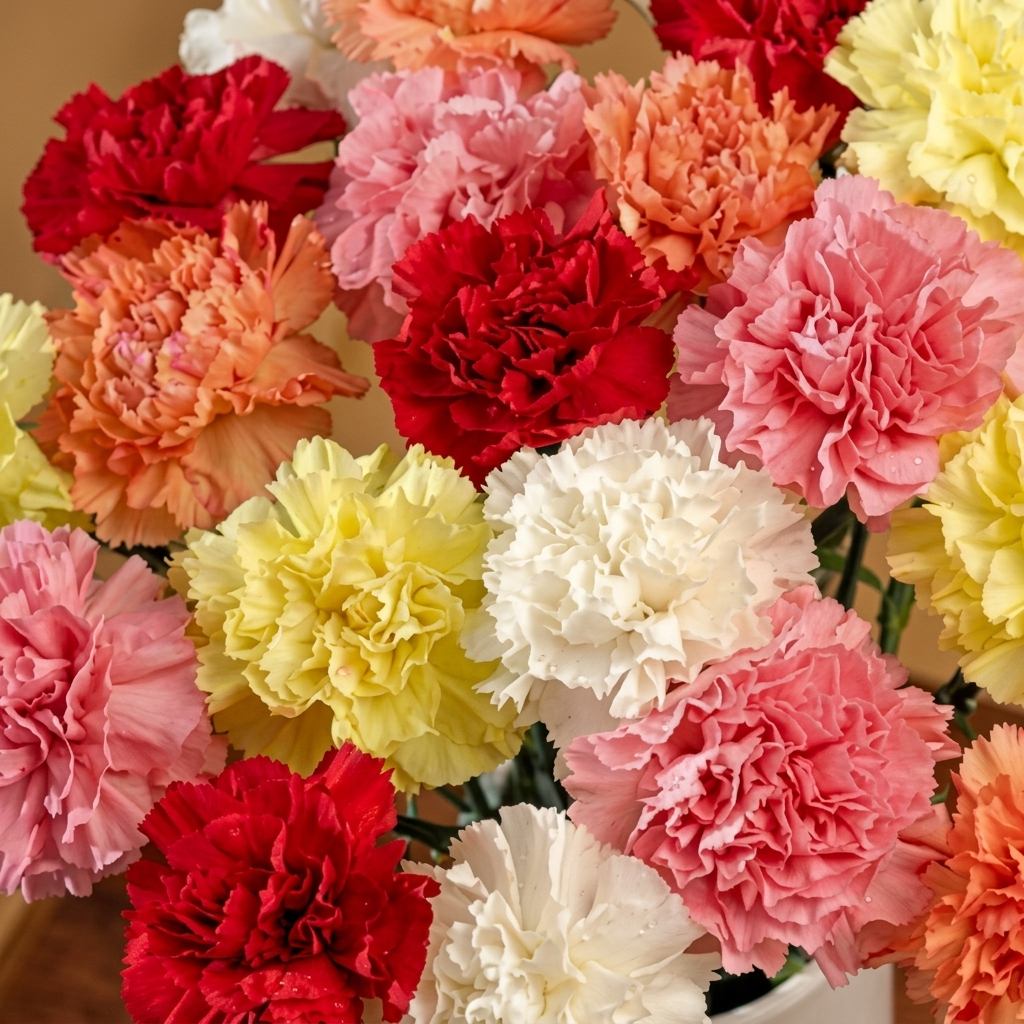
From a Tiny Seed to Clove-Scented Summer Flowers
A friendly guide to sowing, growing, cutting and enjoying carnations in Hungary.
Come Into the Garden With Me…
Today, we're growing carnations.
And I have to admit, carnations are one of those flowers many of us think we already know. We see them in bouquets, at florists, in old family photographs and sometimes in arrangements that have travelled a very long way before reaching the vase.
But a carnation growing in your own garden is a different experience. The petals are softer. The colours feel less artificial. And when you lean close to some varieties, there is that wonderful spicy, clove-like fragrance that explains why carnations have been loved for centuries.
The carnation we'll concentrate on in this book is the classic garden carnation, Dianthus caryophyllus, and especially the Grenadin type sold by Holland Kertészet. This is not simply a quick annual that flowers once and disappears. It can behave as a biennial or short-lived perennial, and it rewards us for thinking beyond a single season.
That means our journey is slightly slower than with marigolds or candytuft. We may start seed in spring and see some flowers later, or sow in summer, grow a sturdy little plant through autumn, let it overwinter, and enjoy a much stronger display the following year.
We'll talk about sunshine, drainage, Hungarian winter wet, pinching, supporting stems, fragrance, cutting for the vase and what to do when a plant becomes woody or tired.
And by the end, I hope you'll stop thinking of carnations as florist flowers and start seeing them as garden plants again.
Ready? Let's find them a sunny place.
1. Meet the Carnation
The botanical name of the classic carnation is Dianthus caryophyllus. The word Dianthus comes from Greek roots often translated as 'divine flower', which feels rather grand for a plant that is surprisingly practical in the garden.
Carnations form narrow, blue-green to grey-green leaves and upright stems carrying flowers that may be single, semi-double or fully double. The petals often have softly toothed or fringed edges, giving each bloom that familiar ruffled appearance.
That famous scent
Not every modern carnation is strongly scented, but many traditional garden types have a spicy fragrance often compared with cloves. On a warm morning, especially when several plants are flowering together, that scent can become one of the loveliest reasons to grow them yourself.
Annual, biennial or perennial?
This is where labels can become confusing. Dianthus as a group includes annuals, biennials and perennials. Dianthus caryophyllus itself is a perennial species, but seed-grown Grenadin carnations are often treated as biennials or short-lived perennials in practical garden culture.
That means a young plant may spend its first season building roots and foliage, then flower much more generously after winter. In a suitable site, some plants can continue for several years, although they may become woody and less productive with age.
|
GOOD TO KNOW Carnations are not the same as all the little garden 'pinks' you may see under the name Dianthus. They are relatives, but the classic carnation is Dianthus caryophyllus: usually taller, excellent for cutting, and often wonderfully clove-scented. |
2. Finding the Right Place
Before we sow a single seed, let's walk around the garden.
Carnations want sunshine. Give them a position where they receive plenty of direct light, because good sun helps build sturdy plants, encourages flowering and keeps growth compact rather than soft and stretched.
Drainage is the real secret
If I could choose only one thing to get right with carnations in Hungary, it would be drainage. They can cope with summer warmth much better than they can cope with roots sitting in cold, wet soil for weeks.
A sunny bed with ordinary garden soil that drains freely is often better than a rich bed that stays soggy after rain. If you have heavy clay, improve the structure, raise the planting area slightly, or grow carnations in a large container where drainage is easier to control.
Hungarian winters
Cold itself isn't always the biggest problem. A well-established garden carnation can tolerate frost surprisingly well, depending on the variety and the exact site. What causes more trouble is the combination of freezing weather and persistently wet soil around the crown and roots.
So if you're gardening in a colder part of Hungary, don't automatically assume you need to bring every plant indoors. First ask whether the site is sheltered from icy wind and whether excess winter water can escape.
|
A COMMON MISTAKE Planting carnations into the richest, wettest part of the garden because we want to 'give them the best'. They usually prefer something leaner and freer-draining. Think sunny border, gravelly edge, raised bed or a large pot with excellent drainage. |
3. The Carnation We Grow With You
In the current Holland Kertészet range, you'll find Carnation 'Grenadin' - 0.5 g. Grenadin is an old-fashioned seed-grown carnation type valued for compact growth, fragrant double flowers and good cutting stems.
Why Grenadin?
I like Grenadin for this series because it teaches us patience without being difficult. You can raise it from seed yourself, watch the small blue-green plants establish, carry them through a Hungarian winter, and then see why gardeners kept these carnations in cottage gardens long before supermarket bouquets existed.
Grenadin carnations are commonly offered in strong traditional shades such as red, rose, pink, white and yellow, depending on the mix or selection. The overall feeling is classic rather than trendy: ruffled flowers, neat foliage and that spicy carnation character.
Where I would plant them
I would give Grenadin a sunny place near a path or terrace where I can smell the flowers. I would also plant several together rather than scattering one plant here and one plant there. A small group gives you enough stems to cut without making the garden look empty afterwards.
They combine beautifully with lavender, salvia, yarrow, baby's breath, scabiosa and ornamental grasses. In a cutting patch, they also work wonderfully with annual asters, cosmos and later summer flowers.
|
GROW WITH US When you sow Holland Kertészet Grenadin carnations, remember that this is a plant worth giving a permanent-looking place. We aren't simply filling a gap for one summer. We're starting a small clump that may reward us again next year. |
4. Let's Sow
Carnation seed is large enough to handle without a magnifying glass, which already makes this easier than begonia.
You have two useful approaches in Hungary. Start seed indoors or under protection in late winter to spring if you want to give plants the longest possible first season. Or sow in early to midsummer and grow sturdy young plants that can be planted out in time to establish before winter.
Starting under protection
Fill a seed tray or small modules with a fine, free-draining seed compost. Moisten it first, then sow the seeds thinly. Cover them lightly with compost or vermiculite rather than burying them deeply.
Keep the tray evenly moist but not saturated and place it somewhere bright once seedlings appear. Good light is especially important because carnation seedlings can become thin and stretched if they spend too long leaning toward a dark window.
Sowing for next year
If you sow in summer, the goal isn't necessarily to produce flowers immediately. We're building a compact young plant with a good root system. Once large enough, the seedlings can be transplanted and given time to settle into their permanent positions before cold weather arrives.
This slower route is very natural for Grenadin. The first year becomes the foundation; the following summer becomes the reward.
|
DON'T PANIC No flowers in the first season? That does not mean you've failed. Grenadin carnations often give their best display after they have overwintered. A healthy little clump of blue-green leaves going into autumn is already a success. |
5. From Seedling to Sturdy Plant
Once the seedlings have several true leaves and are large enough to handle comfortably, give them more room.
Potting on
Move crowded seedlings into individual pots or larger modules. Hold them by a leaf rather than squeezing the stem, settle the roots gently into fresh compost, and water them in.
From this point onward, strong light and sensible watering matter more than pampering. We want stocky plants, not pale seedlings that fall over the moment they meet a Hungarian spring breeze.
Pinching for more stems
When young plants are growing strongly, pinching out the tip can encourage branching. Instead of one main stem racing upward, the plant responds by making side shoots, which can eventually mean more flowering stems.
Don't pinch a struggling seedling. Wait until the plant is established and actively growing. Gardening advice only works when the plant is ready for it.
Planting out
Harden indoor-raised plants gradually before moving them permanently outdoors. Choose your sunny, well-drained place and give plants enough room for air to circulate. Around 25-30 cm apart is a useful garden starting point for many Grenadin-type carnations.
|
WHAT I WOULD DO I would plant three to five carnations together in a small group. That gives you a stronger visual effect, enough flowers for cutting, and a better chance of noticing which individual plants are the strongest for future cuttings or seed saving. |
6. Growing Strong Carnations
Established carnations are not especially thirsty plants, but they do need consistent care while roots are developing and during long dry spells.
Water deeply, then let the soil breathe
Water when the soil is becoming dry rather than keeping the surface permanently damp. In a hot Hungarian summer, container-grown carnations may need attention much more often than plants rooted deeply in the ground.
Try to water the soil rather than constantly wetting the foliage and crown. Good air movement helps reduce fungal problems, especially when summer weather turns humid after storms.
Feeding
Carnations don't need endless high-nitrogen feeding. Too much lush growth can create soft stems and fewer flowers. In ordinary garden soil, a modest spring feed or compost is usually enough. Container plants may need more regular feeding because nutrients wash out with watering.
Do they need support?
Some flowering stems may lean or flop, especially after heavy rain. If you're growing mainly for cutting, a discreet support grid or a few stakes can keep stems straighter. Put support in place before the plants become a tangled mass; it's much easier that way.
|
GOOD TO KNOW Carnations generally prefer neutral to slightly alkaline, well-drained soil. If your soil is strongly acidic, growth may be less satisfactory. But don't start adding lime blindly—know your soil first. |
7. When Something Goes Wrong
Carnations are sturdy plants, but they have a few predictable problems.
The base is turning brown or soft
Think drainage first. Crown and root problems often become worse where soil stays wet and air cannot move around the plant. Remove badly affected material and correct the conditions rather than simply adding more water or fertiliser.
Powdery coating on the leaves
Powdery mildew can appear during stressful or crowded conditions. Improve spacing and airflow, avoid excessive soft growth from overfeeding, and remove badly affected material when necessary.
Orange or rusty marks
Carnations can suffer from rust. Remove affected leaves, keep the bed clean and avoid leaving wet foliage packed tightly together. If a problem becomes serious, use only a treatment appropriate for home gardens and currently authorised in Hungary.
Aphids and slugs
Aphids may gather on tender new growth and buds, while slugs and snails can damage young plants. Check regularly rather than waiting until the problem is obvious from across the garden.
Plants are tall but weak
Too little light, too much nitrogen or overly rich, wet conditions are common reasons. More fertiliser is not the answer to every weak plant. Sometimes the plant is simply asking for more sun and firmer treatment.
|
A COMMON MISTAKE Keeping old carnation plants forever because they are technically perennial. If a clump becomes woody, sparse and increasingly unhealthy, replace or renew it. A younger plant can be far more beautiful than an elderly plant we're keeping out of sentiment. |
8. Flowers, Fragrance and Cutting
And then the buds begin to swell.
Carnation buds are wonderfully satisfying because the flower seems packed far too tightly inside them. Then the sepals loosen, the ruffled petals begin to show, and suddenly the whole plant looks different.
For the garden
Leave plenty of flowers outside and deadhead those that fade. Removing spent blooms keeps the plant tidy and encourages it to direct energy into new growth and flowers rather than seed.
For the vase
Carnations are famous cut flowers for good reason. Cut stems when buds are showing colour and beginning to open, or when the first flower on a stem is freshly open, depending on the effect you want.
Use clean, sharp snips. Remove leaves that would sit below the waterline and place the stems into clean water promptly. Carnations can have excellent vase life, especially when picked from your own garden and moved only a few metres rather than hundreds of kilometres.
And don't forget to smell them
If your Grenadin flowers are fragrant, don't rush past that detail. Put a few near the garden table or in a small vase beside your desk. The spicy scent is one of the things that makes home-grown carnations feel so different from anonymous florist stems.
|
TRY THIS Cut five carnations at slightly different stages: one coloured bud, two just opening and two fully open. Put them together in a simple vase. You'll get a bouquet that continues changing for several days rather than looking exactly the same from the first moment. |
9. After Flowering and Through Winter
When the main flowering flush begins to slow, don't immediately pull the plants. Remember: these are not necessarily one-season flowers.
Deadhead or save seed?
If you want more flowers and a neat plant, keep deadheading. If you'd like to collect seed, leave a few strong flowers to mature naturally. The seed capsules will dry and eventually contain mature seed that can be collected in dry weather.
Preparing for winter
As autumn arrives, reduce feeding and let the plants harden naturally. Avoid leaving a thick, damp blanket of mulch pressed against the crown. In colder or very exposed gardens, a light airy winter protection can be useful, but don't trap moisture around the plant.
Container-grown carnations are more vulnerable because roots in a pot experience colder temperatures than roots protected by the ground. Move valuable pots to a sheltered position where they are protected from prolonged saturation and the harshest freezing winds.
Renewing older plants
If a plant becomes woody after a few seasons, you can start new plants from seed again, or take cuttings from healthy non-flowering shoots in summer. That is one of the pleasures of carnations: a favourite plant doesn't have to disappear when the original clump gets old.
|
WHAT I WOULD DO I would keep a few of the strongest plants through winter and also sow a small new batch each year. That way the garden always contains a mixture of established flowering plants and younger replacements coming along behind them. |
10. Your Carnation Cheat Sheet
Let's put the whole journey into one easy path.
Choose Holland Kertészet Grenadin - 0.5 g for a classic seed-grown carnation.
Give plants full sun and free-draining soil.
Start seed early under protection, or sow in summer for stronger flowering the following year.
Cover seed lightly, keep it moist while germinating and give seedlings bright light.
Pinch sturdy young plants if you want more branching, then harden them before planting outside.
Space plants for airflow and water deeply rather than keeping the soil constantly wet.
Feed modestly and support tall flowering stems if needed.
Watch for aphids, slugs, mildew, rust and poor drainage.
Deadhead regularly, cut flowers with clean tools and save seed from a few blooms if you like.
Keep the crown from sitting wet through winter and renew ageing woody plants from seed or cuttings.
If You Remember Only Five Things…
1. Carnations want sun
Give them a bright position for sturdy growth and plenty of flowers.
2. Drainage is more important than luxury
A lean, free-draining bed is safer than rich soil that stays wet in winter.
3. Grenadin rewards patience
Don't worry if the first season is mostly leaves; the best display may come after winter.
4. Keep cutting and deadheading
Cutting and deadheading help keep the plant productive and tidy.
5. Smell the flowers
Fragrance is one of the joys of home-grown carnations. Take the extra second.
One Last Walk Around the Garden
Do you remember where we started? With a packet of seed and a flower we thought we already knew.
We raised the seedlings, planted them into sunshine and learned not to drown them with kindness. Some may flower in the first season; others will spend that year building roots and blue-green leaves before winter.
Then the following summer, stems rise, buds swell and the first ruffled flowers open - perhaps with that little surprise of spicy fragrance when you lean closer.
Cut some for the house, leave some outside, and save seed or take a cutting from a favourite plant. Enjoy the colour, the ruffles and the scent - and when you're ready for the next plant…


