

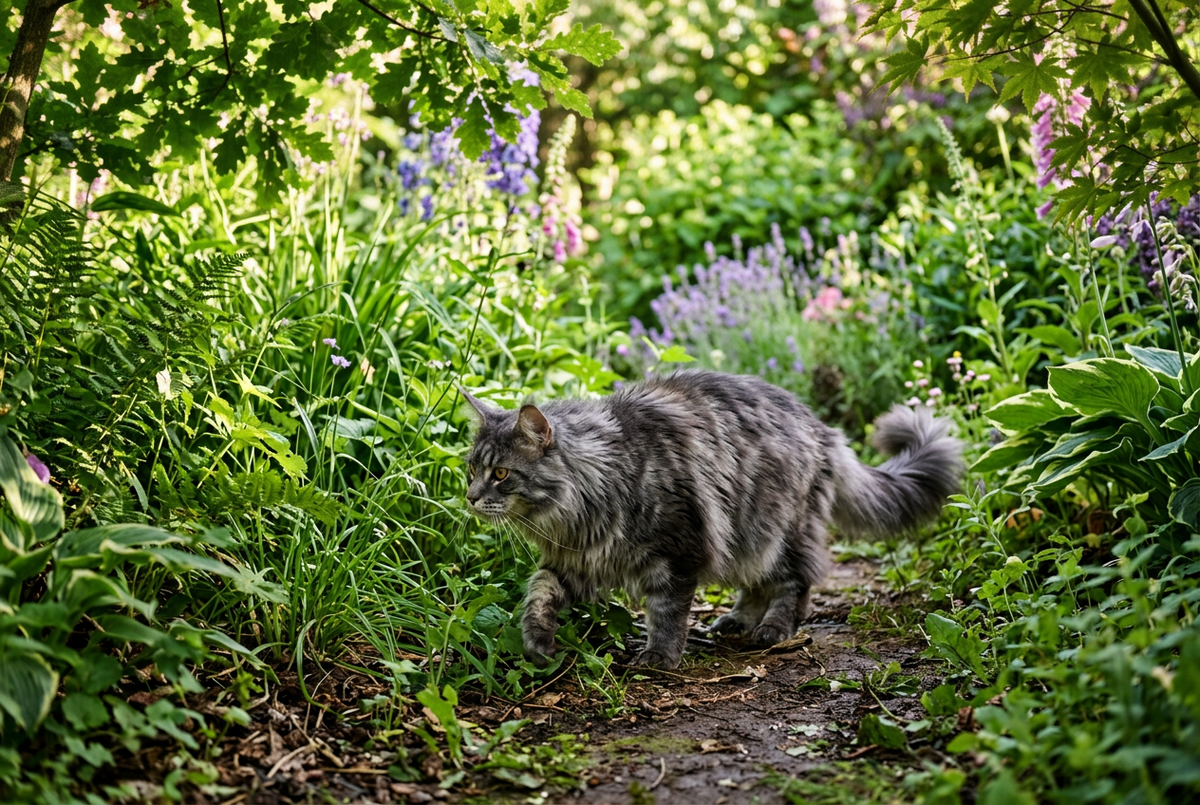
Discover how your cat experiences the garden, which plants and hiding places make them happy, what they need to feel secure, and which common garden dangers you should avoid.
Introduction: Have You Ever Wondered How Your Cat Sees Your Garden?
Have you ever watched your cat sitting quietly in the garden, staring at something you cannot see?
Perhaps they are sitting beneath a rose bush, watching a butterfly move between the flowers. Or maybe they have discovered the warmest patch of sunshine on the terrace and are lying there with their eyes half closed, apparently without a care in the world.
And then, suddenly, they jump up and disappear into the bushes as though they have received an urgent appointment.
Cats are fascinating garden companions.
To us, a garden is a place of flowers, vegetables, beautiful colours and perhaps a comfortable chair where we can enjoy our morning coffee.
But to a cat, the same garden is an entirely different world.
It is a landscape filled with scents, sounds, movement, hiding places, interesting textures and endless opportunities for exploration.
Every shrub has a purpose. Every rustling leaf deserves investigation. A sunny stone becomes a luxurious bed, while a small gap beneath a hedge may be the perfect observation post.
But how do our cats actually feel when they are outside?
Are they happy? Relaxed? Excited? Sometimes frightened?
And perhaps most importantly, how can we design a garden that allows them to enjoy themselves while keeping them safe?
Today, I would like to invite you to look at your garden from a completely different perspective.
Not through the eyes of a gardener.
But through the eyes of a cat.
You may discover that a few small changes can make an enormous difference to your feline companion.
1. How Cats Experience the Garden: A World We Barely Notice
Before we start choosing plants and designing special places for our cats, it helps to understand how they experience their surroundings.
Cats do not see, smell or hear the world in quite the same way we do.
Their senses are adapted for detecting movement, recognising scents and noticing sounds that we may completely overlook.
Their sense of smell tells them a story
When your cat walks through the garden, they are not simply enjoying the fresh air.
They are collecting information.
Cats have a much more sensitive sense of smell than humans. Scent helps them recognise familiar places, identify other animals and understand what has been happening in their territory.
That is why your cat may spend several minutes carefully investigating a flowerpot or the corner of a garden wall.
Perhaps another cat visited during the night.
Perhaps a hedgehog passed through.
Or perhaps you moved a pot and disturbed a familiar scent.
To your cat, these small changes are interesting news.
Cats also use scent to create familiarity.
When they rub their cheeks against a chair leg, tree trunk or garden bench, they deposit scent from glands around their face.
This helps make their surroundings feel familiar and secure.
So when your cat lovingly rubs against your favourite garden furniture, they are not necessarily admiring your excellent taste.
They may simply be making it part of their territory.
Their hearing is incredibly sensitive
Cats can detect higher-frequency sounds than humans.
A small animal moving through dry leaves or an insect buzzing nearby may immediately attract their attention.
This explains why your cat sometimes sits perfectly still, ears moving independently, while you cannot hear anything unusual.
The garden is full of sounds that are meaningful to them.
Unfortunately, sudden loud noises can also be frightening.
Lawnmowers, hedge trimmers, construction work and fireworks may cause considerable stress.
A cat-friendly garden should therefore include quiet places where a cat can retreat when the outside world becomes overwhelming.
Movement is especially interesting
Cats are excellent at noticing movement.
A fluttering leaf, a flying insect or a bird hopping along a fence can immediately trigger their hunting instincts.
Their vision is particularly well adapted to low-light conditions, although they do not see the world in the same colour range or sharpness as humans.
For cats, the garden is not just something to look at.
It is something to investigate.
And that is one of the reasons outdoor spaces can provide such valuable mental stimulation.
2. What Makes a Cat Feel Happy in the Garden?
A happy cat does not necessarily need a large garden.
In fact, a small, secure garden with interesting places to explore may be more enjoyable than a huge, exposed area.
What matters most is whether the cat feels safe, comfortable and able to make choices.
Cats generally appreciate having some control over their surroundings.
They like being able to decide when to explore, when to hide, when to rest and when to observe.
A garden that offers these possibilities can support their natural behaviour.
Freedom to explore safely
Exploration is important for many cats.
New scents, different surfaces and changing seasonal conditions provide stimulation.
However, freedom does not have to mean unrestricted access to the neighbourhood.
A secure cat enclosure, often called a catio, or a properly cat-proofed garden can offer outdoor experiences while reducing risks from traffic, unfamiliar animals and other hazards.
Some cats also enjoy supervised outdoor time using a well-fitted harness, although not every cat accepts harness training.
The important thing is to introduce outdoor experiences gradually and respect the individual cat's personality.
A confident, adventurous cat may enjoy exploring every corner.
A shy cat may prefer sitting quietly near the house.
Both can be perfectly content.
Familiar surroundings
Cats often find predictable environments reassuring.
A favourite resting place, a familiar route through the garden and a reliable way back indoors can all help them feel secure.
Sudden changes may cause temporary uncertainty.
If you completely redesign your garden, remove established shrubs or introduce unfamiliar animals, your cat may need time to adjust.
This does not mean you should never change anything.
Simply allow your cat to become familiar with new surroundings at their own pace.
The ability to retreat
Perhaps the most important feature of a cat-friendly garden is somewhere to escape.
A cat should never feel trapped in an exposed space.
They need routes back to safety and places where they can hide from unfamiliar people, dogs or other cats.
Dense but safe planting, sheltered corners and small outdoor structures can provide these opportunities.
A happy cat is often one that knows exactly where to go when something unexpected happens.
3. Sunshine: A Cat's Favourite Garden Luxury

If you share your home with a cat, you have probably noticed their extraordinary ability to find sunshine.
A small patch of sunlight on the floor becomes the most desirable place in the house.
Outside, the same principle applies.
Cats often enjoy resting in warm, sunny locations.
A sheltered terrace, a flat stone or a wooden bench can become a favourite resting spot.
Sunshine may help a cat feel comfortably warm, especially during cooler weather.
But there is an important difference between pleasant warmth and dangerous heat.
The importance of shade
During Hungarian summers, temperatures can become extremely high.
Paving stones, dark surfaces and enclosed garden spaces may become much hotter than the surrounding air.
Cats can suffer from heat stress and heatstroke.
They must always have access to cool, shaded places and fresh drinking water.
A garden with sunshine but no shade is not a safe environment during hot weather.
Consider planting shrubs that provide afternoon shade, adding a ventilated shelter or creating a shaded resting area beneath a pergola.
Avoid enclosed structures that become dangerously hot.
Remember that the sun moves during the day.
A place that is shaded at nine in the morning may be fully exposed by early afternoon.
My gardening advice: Create several resting places with different amounts of sunlight. Your cat can then choose where they feel most comfortable.
4. Hiding Places: Why Cats Love Shrubs and Secret Corners

Have you ever searched everywhere for your cat, only to discover them sitting beneath a shrub, watching you with an expression suggesting they have been there all along?
Cats often enjoy sheltered spaces.
A hiding place allows them to observe their surroundings without feeling exposed.
This behaviour is connected to their natural instincts.
Cats are predators, but they are also relatively small animals that may need to avoid larger threats.
Having somewhere to hide can therefore contribute to their sense of security.
Creating natural hiding places
You do not need expensive equipment.
A few well-positioned shrubs can create wonderful sheltered areas.
Choose plants that are appropriate for your climate and that are not known to be toxic to cats.
Avoid sharp thorns, irritating sap and plants that may cause injury.
You can also create a sheltered space beneath a raised garden bench or use a sturdy outdoor cat house.
Make sure any structure is stable, well ventilated and easy for the cat to leave.
A hiding place should never become a trap.
More than one escape route
This is especially important in gardens visited by several cats.
A narrow hiding place with only one entrance may become stressful if another animal blocks the exit.
Whenever possible, create sheltered areas with more than one escape route.
This allows a cat to retreat without feeling cornered.
5. Cats Love to Climb: The Garden as a Three-Dimensional World
To a cat, the garden does not end at ground level.
Fences, tree trunks, benches, walls and raised platforms are all potential observation points.
Many cats enjoy climbing because it allows them to explore and watch their surroundings from above.
A raised position may also help a cat feel more secure.
Safe climbing opportunities
You can provide sturdy wooden platforms, low climbing structures or purpose-built outdoor cat furniture.
Ensure that everything is stable and free from sharp edges.
Avoid structures that allow your cat to escape from an otherwise secure enclosure.
And be careful with high platforms above hard surfaces.
Although cats are agile, falls can still cause serious injuries.
Older cats may benefit from lower platforms and gradual steps rather than difficult jumps.
A garden lookout
One lovely idea is to create a sheltered observation platform overlooking part of the garden.
Position it where your cat can watch movement without needing to chase wildlife.
A comfortable platform near a window can also allow indoor cats to enjoy the garden safely.
Sometimes watching is just as entertaining as exploring.
6. Cat Grass: A Little Patch of Green Just for Them

One of the simplest additions to a cat-friendly garden is a pot of cat grass.
Many cats occasionally chew grass.
The reasons are not completely understood. Grass eating may be part of normal feline behaviour, but it should not be regarded as a necessary treatment for digestive problems or hairballs.
Some cats seem to enjoy the texture and experience.
Others show little interest.
What is cat grass?
Cat grass is not one particular botanical species.
It is usually a mixture or selection of young cereal grasses, such as:
-
Oats
-
Wheat
-
Barley
These grasses can be grown easily in pots or trays.
Choose untreated seeds intended for this purpose and avoid using grass that has been exposed to pesticides, herbicides or other chemicals.
How to grow cat grass
Fill a shallow container with suitable potting compost.
Sow the seeds fairly closely together, cover lightly and water gently.
Keep the compost moist but not waterlogged.
Place the container somewhere bright.
Depending on temperature and seed type, the grass may begin germinating within a few days.
Once it has grown sufficiently, you can offer it to your cat.
Keep the pot clean and replace the grass if it becomes mouldy or starts deteriorating.
Cat grass is a pleasant enrichment option, but it should never replace a complete, balanced cat diet.
7. Catnip: A Plant That Can Make Some Cats Very Happy

If there is one plant closely associated with cats, it is catnip.
Its botanical name is Nepeta cataria.
Catnip belongs to the mint family and contains a compound called nepetalactone.
For many cats, smelling catnip produces a noticeable behavioural response.
They may rub against the plant, roll on the ground, become playful or appear unusually relaxed.
The response usually lasts only a short time.
Interestingly, not every cat reacts to catnip.
Sensitivity is influenced by genetics, and young kittens often show little or no response.
Growing catnip in Hungary
Catnip is generally a hardy perennial suitable for many Hungarian gardens.
It prefers a sunny position and well-drained soil.
Once established, it can tolerate some dry conditions.
However, young plants may need protection.
An enthusiastic cat can flatten a small catnip plant very quickly.
You might consider planting several specimens or protecting young plants with a temporary barrier until they become established.
Catnip versus ornamental catmint
Garden centres often sell ornamental plants under the name catmint.
These are frequently Nepeta hybrids or species grown for their attractive flowers.
They are not necessarily the same as true catnip, Nepeta cataria.
Some cats respond to ornamental catmints, while others do not.
If you specifically want the classic catnip experience, look for the botanical name Nepeta cataria.
Offer catnip in moderation and observe your cat's response. If it causes agitation or excessive excitement, remove it.
8. Other Plants Cats May Enjoy
Catnip is not the only plant that can interest cats.
Some cats respond to valerian root or silver vine, although individual reactions vary.
Silver vine, Actinidia polygama, is particularly interesting because some cats that do not respond to catnip may respond to silver vine.
However, these plants are not automatically suitable for every garden or every animal.
For example, a climbing plant may require considerable space and support, and any plant material offered for chewing should be assessed carefully.
What about lavender?
Lavender is a beautiful Mediterranean-style plant that grows well in many sunny Hungarian gardens.
However, lavender contains compounds that can be harmful to cats if ingested.
It is therefore not a plant I would recommend specifically for a cat's chewing or play area.
Concentrated lavender essential oil is especially concerning.
The same caution applies to many other strongly scented plants and essential oils.
Natural does not automatically mean safe.
Safer ornamental choices
Some plants commonly considered non-toxic to cats include certain roses, zinnias, snapdragons and sunflowers.
However, plant identity matters.
A common name can refer to several different species, and non-toxic does not mean that eating large quantities is harmless.
Before planting anything in an area where your cat regularly chews vegetation, verify the exact botanical species using a reliable veterinary plant-toxicity resource.
9. The Most Dangerous Garden Plants for Cats

This may be the most important section of the entire article.
Many beautiful garden plants contain substances that can harm cats.
Some cause mild digestive upset.
Others can lead to serious poisoning.
And a few are dangerous enough that they should be excluded entirely from any area a cat can access.
Lilies: an extremely serious danger
True lilies, belonging to the genus Lilium, and daylilies, belonging to Hemerocallis, are extremely dangerous to cats.
Exposure can cause severe, potentially fatal kidney injury.
All parts of these plants are dangerous, including leaves, flowers and pollen.
Even drinking water from a vase containing lilies can be hazardous.
If you own a cat, the safest choice is not to grow true lilies or daylilies anywhere the cat can reach them.
Do not assume that a cat will avoid them.
Autumn crocus
Autumn crocus, Colchicum autumnale, is another dangerous plant.
It contains colchicine and related compounds that can cause severe poisoning.
Despite its common name, it is not the same plant as the familiar spring-flowering crocuses of the genus Crocus.
This distinction is important.
Daffodils and narcissus
Daffodils, belonging to the genus Narcissus, contain toxic alkaloids.
The bulbs are particularly concentrated sources, but other parts can also be harmful.
Ingestion may cause vomiting, drooling and other symptoms, with more serious effects possible.
Tulips and hyacinths
Tulips and hyacinths can also cause poisoning.
Their bulbs contain higher concentrations of irritating or toxic compounds than many other plant parts.
This is especially relevant in autumn when we are planting spring-flowering bulbs.
Cats may investigate freshly disturbed soil or play with loose bulbs.
Always store bulbs securely and never leave them scattered where pets can chew them.
Oleander
Oleander, Nerium oleander, is a highly poisonous ornamental shrub.
It contains cardiac glycosides that can affect the heart.
It should be kept away from cats and other pets.
Other plants requiring caution
Cyclamen, azaleas, rhododendrons, foxgloves and some other popular ornamentals can also be toxic.
This is not a complete list.
Important: If you suspect that your cat has chewed or swallowed a poisonous plant, contact a veterinarian immediately. Do not wait for symptoms and do not try to make the cat vomit at home.
With possible lily exposure, urgent veterinary attention is essential even if the cat initially appears completely normal.
10. A Safe Garden Is More Than Choosing Safe Plants
Plants are only one part of garden safety.
Many ordinary gardening products and activities can create risks.
Slug and snail pellets
Some slug-control products contain substances that are dangerous to pets.
Metaldehyde-based products are particularly hazardous.
Never assume that a product is safe simply because it is sold for garden use.
Read the label carefully and follow all safety instructions.
In a garden regularly used by cats, consider non-chemical approaches such as hand-picking slugs, protecting vulnerable plants and improving garden hygiene.
Pesticides and herbicides
Insecticides, weedkillers and other garden chemicals may pose risks through direct contact, ingestion or contaminated surfaces.
The level of risk depends on the product, formulation and exposure.
Use only products legally approved for the intended purpose, follow the label and keep cats away for the required period.
Where possible, choose gardening methods that minimise chemical use.
Fertilisers
Some fertilisers, particularly concentrated products or those containing ingredients attractive to animals, can be harmful if eaten.
Store all fertilisers in sealed containers.
Do not leave open bags or piles of fertiliser accessible.
Cocoa shell mulch
Cocoa shell mulch may contain theobromine and caffeine, substances that can be harmful to pets.
Although the greatest concern is often discussed in relation to dogs, it is sensible to avoid this mulch in gardens where cats may chew or ingest it.
Sharp tools and garden machinery
Always check beneath shrubs and around equipment before mowing or using a strimmer.
Cats sometimes sleep in places we do not expect.
Keep sharp tools safely stored and prevent cats from entering sheds or garages unnoticed.
11. Water: Something Every Cat-Friendly Garden Needs

Fresh water is essential.
This is particularly important during hot Hungarian summers.
Place a stable bowl of clean drinking water in a shaded location.
Change the water regularly and clean the bowl to prevent algae and bacterial growth.
Some cats prefer wide, shallow bowls because they do not like their whiskers touching the sides.
Others enjoy drinking from moving water.
A pet drinking fountain may encourage some cats to drink more, provided it is kept clean and used safely.
What about ponds?
Garden ponds can attract curious cats.
A pond should have shallow edges or secure escape routes so that an animal can climb out if it falls in.
Avoid steep-sided water containers and uncovered rain barrels.
Never leave a cat with access to a container from which it cannot escape.
12. The Importance of Quiet Resting Places
Cats spend a large proportion of their lives resting and sleeping.
A garden should therefore offer comfortable places where they can relax without being disturbed.
A sheltered wooden platform, a dry outdoor cat bed or a covered bench may become a favourite resting spot.
Position resting places away from busy gates, loud machinery and areas regularly visited by unfamiliar animals.
A comfortable winter shelter
During colder months, an outdoor shelter should be dry, protected from wind and appropriately insulated.
It should also remain well ventilated.
Straw is often used as bedding in outdoor cat shelters because it resists moisture better than many fabrics.
Damp blankets can become cold and uncomfortable.
However, an outdoor shelter is not a substitute for a warm indoor home, particularly for kittens, elderly cats, sick cats or animals poorly adapted to cold weather.
Cats should have reliable access to appropriate indoor shelter.
13. Cats and the Vegetable Garden: Can They Live Happily Together?
If you grow vegetables, you may already have discovered that cats have their own ideas about freshly prepared soil.
A beautifully raked seedbed can look remarkably similar to a giant litter tray.
Unfortunately, this is not ideal for growing vegetables.
Cat faeces may contain pathogens, including Toxoplasma gondii, which can present health risks.
How to protect vegetable beds
Use physical barriers where necessary.
Raised beds can be protected with suitable covers or netting that does not create an entanglement hazard.
You can also provide a designated outdoor toileting area in a quiet location.
Keep it clean and maintain an appropriate indoor litter tray as well.
Avoid using irritating substances such as chilli powder, essential oils or other homemade deterrents that may harm cats.
What about freshly planted bulbs?
Cats sometimes enjoy digging in newly prepared soil.
If you have just planted tulips, daffodils or hyacinths, use a safe temporary barrier to discourage digging.
This protects both your planting work and your cat from contact with potentially toxic bulbs.
14. Cats, Birds and Other Garden Wildlife
This is a subject that deserves careful attention.
Cats are natural hunters.
Even a well-fed cat may chase birds, mice, lizards or other small animals.
Hunting is not necessarily connected to hunger.
It is part of their instinctive behaviour.
Unfortunately, free-roaming domestic cats can have significant effects on wildlife.
A garden that attracts birds with feeders, flowers and nesting places may also become a hunting area.
How to protect wildlife
The most effective way to reduce hunting is to prevent unsupervised access to wildlife.
A secure cat enclosure or supervised outdoor time allows your cat to enjoy fresh air while reducing risks to birds and other animals.
Bird feeders should be positioned away from places where cats can hide and ambush birds.
However, feeder placement alone cannot eliminate the risk.
Bells on collars may reduce some hunting but are not fully reliable, and collars should be properly fitted, quick-release designs.
Give your cat alternatives
Interactive play can provide opportunities to express hunting-related behaviours without harming wildlife.
Fishing-rod toys, moving toys and food puzzles can be useful.
Allow your cat to stalk, chase and catch a toy.
Short, regular play sessions can be particularly rewarding.
A cat does not need to catch a real bird to enjoy being a cat.
15. What About Other Cats Visiting the Garden?
Not every cat enjoys sharing territory.
Some cats are sociable, while others become stressed when unfamiliar cats enter their surroundings.
An unexpected visitor may lead to staring, hiding, vocalising, chasing or fighting.
Signs of territorial stress
Your cat may begin avoiding certain parts of the garden.
They may appear unusually alert or reluctant to go outside.
Some cats may show changes in grooming, appetite or toileting behaviour.
These signs can also indicate medical problems, so persistent changes deserve veterinary assessment.
Creating a more secure environment
Provide several resting places and escape routes.
Avoid creating narrow areas where one cat can trap another.
If your cat is frequently frightened by visiting cats, supervised outdoor access or a secure enclosure may be preferable.
Never force unfamiliar cats to interact.
16. How to Tell Whether Your Cat Is Happy Outside
Cats communicate through body language.
Learning to recognise their signals can help you understand whether the garden is enjoyable or stressful.
Signs of a relaxed cat
A comfortable cat may walk with a relaxed body, explore at an unhurried pace or settle down in a favourite place.
Their ears are often in a neutral position.
They may groom themselves, stretch or rest with their eyes partly closed.
A gently raised tail can indicate a friendly, confident mood in some situations.
However, body language should always be interpreted as a whole.
Signs of stress or fear
A frightened cat may crouch low, flatten its ears, widen its pupils or attempt to escape.
Some cats freeze.
Others hiss, growl or become defensive.
If your cat repeatedly appears frightened outdoors, investigate what may be causing the problem.
Perhaps another cat is visiting.
Perhaps a nearby dog is barking.
Or perhaps the garden simply feels too exposed.
Do not force a nervous cat to remain outside.
Allow them to return to a safe indoor space.
17. Making a Cat-Friendly Garden for Older Cats
As cats grow older, their needs may change.
Jumping becomes more difficult for some.
Arthritis, reduced vision and other age-related conditions can affect how they move around.
A garden that was perfect for a young, energetic cat may need some adjustments.
Easy access
Provide low steps or ramps to favourite resting places.
Avoid slippery surfaces.
Keep paths clear and remove obstacles that may cause falls.
Comfortable resting areas
Older cats may appreciate warm, sheltered places close to the house.
They should not need to travel far to reach water or return indoors.
Familiarity matters
Avoid unnecessary changes to the layout of an older cat's favourite area.
Predictable routes and familiar resting places can be reassuring.
And remember that an older cat may still enjoy outdoor stimulation even if they are no longer interested in climbing trees or chasing insects.
Sometimes sitting quietly in the sunshine is enough.
18. Kittens in the Garden: A Different Set of Rules
Kittens are curious, energetic and often completely unaware of danger.
They may chew plants, squeeze through tiny gaps or investigate objects that an adult cat would ignore.
For this reason, kittens should not be allowed to roam freely outdoors.
Outdoor experiences should be supervised and appropriate to their age, health and vaccination status.
Ask your veterinarian when outdoor access is suitable.
Introduce the garden gradually
Begin with short, calm visits to a secure area.
Allow the kitten to investigate at its own pace.
Provide familiar objects and an easy route back indoors.
Never leave a kitten unattended in a garden simply because the fence appears secure.
Small gaps can be surprisingly easy to find.
19. A Cat-Friendly Garden Through the Hungarian Seasons
Every season offers something different.
Spring: curiosity and discovery
Spring brings new scents, fresh growth and increasing insect activity.
Cats may become more interested in exploring as the weather improves.
Check that newly planted flowers and bulbs are safe.
Keep cats away from pesticides and fertilisers used during spring garden preparation.
Summer: sunshine and shade
Summer can be wonderful for cats, but heat is a serious concern.
Provide plenty of shade, fresh water and cool resting areas.
Avoid outdoor activity during the hottest part of the day.
Watch for signs of overheating, such as excessive panting, weakness, drooling or collapse.
Heatstroke is an emergency requiring immediate veterinary care.
Autumn: leaves and changing scents
Autumn can be a fascinating season for cats.
Fallen leaves create interesting sounds and textures.
The cooler weather may make outdoor exploration more comfortable.
However, October is also the season when many gardeners plant bulbs and use garden equipment.
Keep toxic bulbs securely stored and check for cats before operating machinery.
Winter: warmth and protection
Some cats enjoy brief visits outdoors during winter.
Others prefer staying indoors.
Always provide access to warmth and shelter.
Check outdoor water regularly to ensure it has not frozen.
Avoid allowing cats to become trapped in sheds, garages or greenhouses.
And be particularly careful with antifreeze.
Ethylene glycol antifreeze is extremely poisonous to cats, even in small amounts.
Clean spills immediately and store products securely.
20. Ten Simple Ways to Make Your Garden Better for Your Cat
You do not need to redesign your entire garden.
Small changes can make a meaningful difference.
-
Provide secure outdoor access. A catio or properly secured garden can reduce risks from traffic and wildlife encounters.
-
Create sunny and shaded resting places. Give your cat choices throughout the day.
-
Offer safe hiding places. Use suitable shrubs or purpose-built shelters with escape routes.
-
Grow cat grass. A pot of untreated cereal grass can provide safe enrichment for cats that enjoy chewing it.
-
Try true catnip. Nepeta cataria may provide enjoyable stimulation for responsive cats.
-
Provide fresh drinking water. Keep bowls clean and shaded.
-
Add safe climbing opportunities. Stable, low platforms are especially useful.
-
Remove highly toxic plants. Above all, avoid true lilies and daylilies in areas accessible to cats.
-
Keep chemicals and tools secure. Prevention is much easier than treating an accident.
-
Respect your cat's personality. Some cats love exploring, while others prefer quietly watching the world.
21. Frequently Asked Questions About Cats in the Garden
Do cats need a garden to be happy?
No. Cats can live happy, healthy lives indoors when their environment provides appropriate stimulation, play, resting places, scratching opportunities and social interaction.
A secure garden or catio can provide additional enrichment, but unrestricted outdoor access is not essential.
Is catnip safe for cats?
Catnip is generally considered safe for most healthy cats when offered in moderation.
Some cats become excited, while others appear relaxed.
If your cat becomes distressed or experiences digestive upset after eating large amounts, remove the plant and consult your veterinarian if necessary.
Why does my cat eat grass?
Grass eating is a common behaviour in cats, but its precise purpose is not fully understood.
Occasional chewing may be normal.
Frequent vomiting, persistent grass eating accompanied by other symptoms or changes in appetite should be discussed with a veterinarian.
Are tulips dangerous for cats?
Yes. Tulips contain compounds that can cause poisoning, especially in the bulbs.
Store bulbs securely and prevent cats from chewing any part of the plant.
Can cats stay outside during winter in Hungary?
Some healthy adult cats tolerate cool weather better than others, but prolonged exposure to freezing conditions can be dangerous.
Access to appropriate indoor warmth and shelter is important.
Kittens, elderly cats and animals with health problems are particularly vulnerable.
How can I stop my cat digging in the vegetable garden?
Use safe physical barriers, protect newly prepared beds and provide an alternative toileting area.
Avoid chemical or irritating homemade deterrents.
Which garden plants should I avoid most?
True lilies and daylilies are among the most serious hazards because exposure can cause life-threatening kidney injury.
Other important risks include autumn crocus, oleander, daffodils, tulips, hyacinths and several additional ornamental plants.
Always verify the botanical identity and toxicity of plants before allowing access.
22. Final Thoughts: A Garden Should Be a Happy Place for Everyone
The next time you see your cat sitting quietly among the flowers, take a moment to watch them.
Notice how their ears move towards a distant sound.
Watch how carefully they investigate a new scent.
See how they choose a sheltered place to rest or stretch themselves out in a patch of sunshine.
For your cat, the garden is much more than a collection of plants.
It is a place of discovery, comfort, excitement and familiar routines.
And as gardeners, we have a wonderful opportunity to make that world safer and more enjoyable.
We can choose plants carefully.
We can create shaded corners and comfortable resting places.
We can provide opportunities for climbing, exploring and playing.
And we can protect both our cats and the wildlife that shares our gardens.
Perhaps the most important lesson is that a cat-friendly garden does not have to be complicated or expensive.
It simply needs to consider the world from a cat's point of view.
A little sunshine.
A comfortable hiding place.
Fresh water.
Something interesting to investigate.
And the freedom to return to safety whenever they wish.
That is a very good beginning.
So next time you are planning a new flower bed or rearranging your garden, spare a thought for your four-legged gardening companion.
After all, we may be the ones buying the plants, digging the holes and pulling out the weeds.
But if you ask the cat, there is probably very little doubt about who the garden really belongs to.
Happy gardening from Holland Kertészet – where we believe a beautiful garden should be a welcoming place for plants, people, wildlife and our much-loved four-legged companions.
Important safety note: This article provides general gardening and pet-welfare information. Plant toxicity and individual animal needs vary. For suspected poisoning, illness or unusual behaviour, contact a veterinarian promptly. For reliable plant-toxicity information, consult veterinary resources such as the ASPCA Animal Poison Control plant database or your local veterinary professional.


