


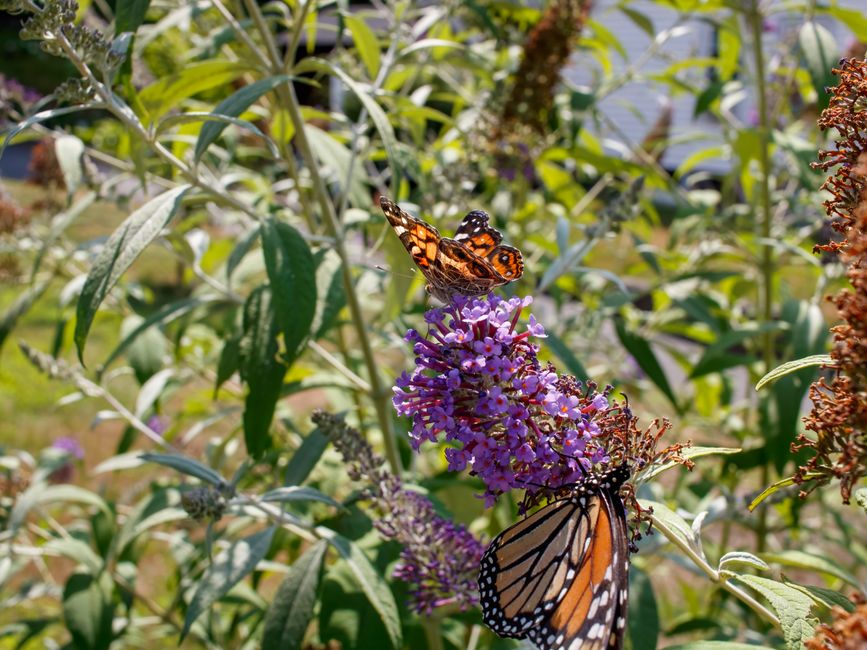
Few shrubs divide opinion in a garden centre quite like the butterfly bush. Walk down any summer border in Britain or Central Europe and you will likely spot at least one Buddleja davidii swaying with peacock and red admiral butterflies. It is beautiful, tough, and fragrant. It is also, depending on who you ask, an ecological menace. So, should you plant one, rip one out, or find a cleverer middle ground? This article weighs the evidence honestly, so you can decide what is right for your space.
Key Takeaways
-
Butterfly bush is genuinely invasive in Europe: Plantura Garden confirms that in Europe, the butterfly bush is considered invasive due to its tendency to spread, escaping garden boundaries and displacing native species. If you grow one, active management is essential.
-
A single plant produces millions of seeds: A single flower cluster can produce over 40,000 seeds, which are dispersed by wind and water and may remain dormant in the soil for many years. Therefore, deadheading every faded spike before seed sets is non-negotiable.
-
Sterile cultivars offer a lower-risk path: as butterfly bush has become problematic worldwide, selective breeding programmes have produced reduced-fertility cultivars sold as sterile or environmentally friendly. If you love the look, start there.
-
Nectar value is real but incomplete: butterfly bush offers pollinators a quick nectar source, but does not provide the full range of resources they need to survive and reproduce. Pair it with host plants if you grow it at all.
-
Responsible pruning is your best tool: Deadheading spent panicles regularly from late July onwards triggers a second flush and prevents seed setting, as Nature-and-Garden.com explains, a single spike can carry tens of thousands of seeds, so this task is as much about ecological responsibility as tidiness.
Start here if you are:
-
A first-time gardener in Britain or Central Europe: Browse the Holland Kertészet plant range first. They bring together expertly sourced shrubs and perennials suited to the Central European climate, so you get the right plant for the right place from the start, that is the fastest route to a garden alive with butterflies.
-
An experienced wildlife gardener: Opt for sterile cultivars or native alternatives, and build a mixed border that supports butterflies at every life stage.
-
Short on time: Native alternatives like Verbena bonariensis and Salvia nemorosa are far lower maintenance and carry no invasive risk.
What Exactly Is the Butterfly Bush?
Origins and Introduction to Europe
Buddleia was introduced to Europe about one hundred years ago from China and has been cultivated since then, according to ScienceDaily's coverage of Helmholtz Centre research. Few shrubs earn their common name as convincingly as the butterfly bush, whose long, tapering flower panicles draw peacocks, red admirals, and painted ladies from July until the first frosts. Nature-and-Garden.com describes Buddleja davidii as a fast, forgiving deciduous shrub with arching grey-green stems and honey-scented blooms in shades of purple, magenta, pink, and white.
According to Wikipedia's entry on Buddleja davidii, it was first documented as an invasive species in 1922 in the UK at Harlech in North Wales. It is now often seen along railway lines and on derelict sites. The plant frequently grew on urban bomb sites after World War II, earning it the nickname "the bomb site plant."
Why Gardens Love It
In my experience, few shrubs deliver such immediate visual reward for so little input. The plant flowers prolifically in its first summer from a hard spring pruning, which is both its greatest virtue and the reason it needs a firm hand. Buddleja needs full sun to flower well, at least six hours of direct light a day, as Nature-and-Garden.com explains. It tolerates poor soils, minimal watering once established, and even the roughest urban corners.
Pro Tip: A sheltered, sun-baked spot beside a wall or in a gravel garden suits butterfly bush perfectly and intensifies the scent. Nature-and-Garden.com notes that sharp drainage matters far more than soil fertility. A south-facing wall and gritty compost will see your plant through most Central European winters.
The Invasive Species Debate: What the Science Really Says
The Spread Problem in Central Europe
According to research on research published in Diversity and Distributions, Buddleja davidii was introduced to North America, South America, Europe, Africa, and New Zealand as an ornamental plant, and its naturalization and invasion have been confirmed in many European countries. This includes countries immediately surrounding Hungary. In Poland, for instance, it is a locally established alien species treated as potentially invasive in semi-natural dry grasslands and calcareous scrubland habitats.
The Non-Native Species Secretariat confirms that this very popular garden plant has escaped cultivation on multiple occasions due to its highly dispersable seed, and over the past few decades has rapidly spread throughout lowland Britain, still increasing its range and frequency. Seeds travel via wind currents along motorways and railways, a sobering thought if your garden borders open land or a river.
The Ecological Trade-Off
The butterfly bush debate boils down to one core tension: it feeds adult butterflies well, but offers almost nothing to their larvae. Because butterfly bushes offer copious amounts of nectar, they become extremely attractive to pollinators, distracting them from other native co-flowering species and reducing the natives' reproductive success, as University of Maryland Extension warns.
One major wildlife gardening myth, according to Gulo in Nature, is that Buddleja offers only sugary nectar with little nutritional value to pollinators. However, studies indicate that its nutritional value, although lower than some natives, is not so poor as to be problematic for butterflies. In other words, Buddleja is not simply "junk food" for nectar-feeders. That is a fair point, but it does not resolve the larval host plant problem.

Pro Tip: As Wild Ones reminds us, providing appropriate food plants for caterpillars, not just nectar plants for adult butterflies, is key to creating genuine butterfly habitat. If you keep a Buddleja, add native caterpillar hosts alongside it: stinging nettle for peacocks and red admirals, and bird's-foot trefoil for common blues.
Butterfly Bush vs. Native Alternatives: A Head-to-Head
Here is the honest comparison garden writers often avoid. I've found that setting plants side by side on the criteria that matter helps cut through the noise.
Butterfly Bush (Buddleja davidii, Wild Type)
Pros:
-
Produces abundant nectar from July to first frost, attracting peacocks, red admirals, and painted ladies
-
Extremely hardy, drought-tolerant once established, and grows in poor soils
-
Fast-growing with a dramatic visual presence in borders
-
Widely available from garden centres and nurseries across Europe
-
Honey-scented flowers make it a sensory delight on warm evenings
Cons:
-
Considered invasive in Europe due to its tendency to spread beyond garden boundaries and displace native species, per the Royal Horticultural Society
-
Provides no larval habitat for European butterfly species
-
Requires regular, thorough deadheading to prevent seeding
-
Left unpruned, Buddleja will quickly develop into a large shrub around 3 metres tall and can take over a smaller garden, as Love the Garden notes
-
Potential to crowd out native plants on adjacent wasteland, riverbanks, and railway verges
Native and Low-Risk Alternatives for Central European Gardens
Verbena bonariensis is the standout European-friendly alternative. It is tall, airy, and absolutely irresistible to butterflies. As Gardenia.net's pollinator garden guide recommends, pairing nectar plants like Verbena bonariensis, Echinacea, Liatris, and Aster creates layered, season-long support for pollinators. It self-seeds gently rather than explosively, and carries no invasive status in Europe.
Salvia nemorosa (woodland sage) is a compact Central European native that blooms in June and again if cut back. According to Gardenia.net's pollinator garden guide, from classic blue to hot pink, salvias are essential plants that attract both bees and butterflies.
Agastache (hyssop) thrives in Hungary's warmer, drier summers and provides nectar-dense spires from July to October. As Gardenia.net's pollinator garden guide notes, Agastache features highly aromatic spires loaded with nectar, perfect for hot, sunny spots.
The Comparison Table
| Plant | Nectar Value | Larval Host | Spread Risk | Maintenance |
|---|---|---|---|---|
| Buddleja davidii (wild type) | Very high | None | High | High (deadheading) |
| Sterile Buddleja cultivar | High | None | Low | Medium |
| Verbena bonariensis | High | Minimal | Very low | Low |
| Salvia nemorosa | Medium-high | Low | None | Low |
| Agastache | High | None | None | Very low |
| Stinging nettle (Urtica dioica) | None | Very high | Medium | Medium |
The verdict: As Bees Knees Substack puts it, butterfly bush is a good reminder that just because a plant attracts pollinators does not mean it is actually supporting those pollinators or providing other critical ecosystem functions. A mixed border of Verbena, Salvia, and Agastache, available through quality European nurseries like Holland Kertészet, will likely outperform a solitary Buddleja on every ecological measure except sheer visual drama.
How to Grow Butterfly Bush Responsibly (If You Choose To)
Pruning: The Single Most Important Task
I've found that people fear pruning Buddleja far more than they should. The plant is almost indestructible. Most UK and European gardens prune Buddleja davidii in early spring (March to May, often April), once hard frosts are easing and buds start to swell. Because it flowers on new growth, a confident cut-back produces stronger stems and bigger flower spikes, according to Garden Wildlife's pruning guide.
Cut all stems back to a low framework of 30-60 cm above ground in spring. As Nature-and-Garden.com explains, this seems brutal but is essential, because buddleja flowers on the current season's wood and unpruned plants become leggy with small blooms.
Deadheading: Your Ecological Duty
Once the flowers fade, Plantura Garden advises removing the flowerheads before seeds form. Otherwise, the buddleia may quickly spread in the garden and all around. Cut each spent spike back to the nearest leaf axil. During peak flowering in July and August, this means checking the plant every ten to fourteen days. The reward is a second and sometimes third flush of blooms.
Pro Tip: Regularly cutting off faded flowers before they go to seed is the most effective way to prevent uncontrolled spread outside the garden. If you live near sensitive habitats, Jardineriaon.com's care guide specifically recommends choosing sterile varieties. In Hungary and Central Europe, where dry open habitats are particularly vulnerable to colonisation, this advice carries extra weight.
Choosing the Right Cultivar
Many gardeners do not realise that not all butterfly bushes behave the same when it comes to seed production. Some older, classic varieties of butterfly bush can produce viable seeds and may self-sow in favourable climates, as Sooner Plant Farm explains. The sensible approach is to seek out certified low-seed or sterile cultivars. The 2024 Year of the Buddleia coverage notes that vendors market cultivars including 'Flutterby Petite Blue Heaven', the Lo & Behold series, 'Miss Molly', and 'Miss Ruby' as non-invasive options.
Making Your Final Decision: The Honest Verdict
After years of looking at this question from multiple angles, my conclusion is this: the butterfly bush is not automatically wrong for every garden, but it demands more responsibility than most gardeners realise when they impulse-buy it from a market stall.
If you garden in a town or city, well away from riverbanks and natural habitats, a sterile cultivar grown in a managed border with diligent deadheading is a reasonable choice. The visual reward and the sheer number of butterflies it draws on a warm August afternoon are genuinely hard to replicate quickly.
If you garden near open countryside, grassland, or watercourses in Hungary or elsewhere in Central Europe, the ecological risks are real. Research confirms that the naturalization and invasion of Buddleja davidii have been confirmed in many European countries, according to studies compiled on research published in Diversity and Distributions. In those situations, a mixed planting of Verbena bonariensis, Salvia nemorosa, and Agastache, sourced from a reliable European nursery like Holland Kertészet, is the choice that looks after both your conscience and your local ecosystem.
The good news is that you do not have to choose between a beautiful garden and a responsible one. The best pollinator gardens in Europe contain both nectar plants for adults and host plants for larvae, layered across the season. That is a more interesting design challenge than simply planting one big shrub, and the results, I've found, are far more rewarding.
Frequently Asked Questions
Is butterfly bush legal to grow in Britain and Central Europe?
According to a horticultural industry guide, Buddleia is not included among the wild invasive non-native plants listed on Schedule 9 of the Wildlife and Countryside Act and is not scheduled for future inclusion. This means growing it in your own garden is legal in Britain. The same broadly applies in Hungary and most of Central Europe, though you should avoid allowing it to spread beyond your boundary and should never plant it near natural habitats or waterways.
How do I stop my butterfly bush from spreading seeds?
Deadhead spent panicles regularly from late July onwards to trigger a second flush and to prevent seed setting, as Nature-and-Garden.com advises. Cut each spent flower spike back to the nearest leaf axil as soon as it begins to fade. If you find the task too demanding, switch to a sterile cultivar, the maintenance burden drops considerably.
When is the best time to prune a butterfly bush in Central Europe?
Prune Buddleja davidii in early spring, typically March to May and often April, once hard frosts are easing and buds start to swell. Because it flowers on new growth, a confident cut-back produces stronger stems and bigger flower spikes, according to Garden Wildlife's guide. In Hungary's continental climate, wait until you are confident there are no more hard frosts before cutting back hard.
Are sterile butterfly bush cultivars genuinely safe to grow?
As Plant Addicts explains, "sterile" does not always mean completely seedless, some low-fertility butterfly bushes can still produce a small amount of viable seed, and some may still exchange pollen with fertile plants nearby. The risk is significantly lower than with wild-type Buddleja, but continued deadheading remains good practice even with sterile cultivars.
What are the best butterfly bush alternatives for a Hungarian or Central European garden?
For a garden in Hungary or the wider Central European region, Verbena bonariensis, Salvia nemorosa, and Agastache are all excellent choices that provide season-long nectar for adult butterflies with no invasive risk. For season-wide pollinator support, Nature Hills Nursery's guide recommends layering plantings so something is always in bloom, starting with early spring salvias, moving into summer coneflowers and verbena, and finishing with late-season sedums. Adding native host plants such as stinging nettle and bird's-foot trefoil completes the habitat. Browse the full range of pollinator shrubs and perennials at Holland Kertészet for options specifically suited to Hungarian growing conditions.
Ready to build a butterfly-friendly garden the responsible way? Explore the curated shrub and perennial range at Holland Kertészet to find cultivars and companion plants suited to Central European gardens.
Sources
-
Buddleja davidii invasive spread research, Helmholtz Centre for Environmental Research / ScienceDaily. Research on Buddleja davidii invasive behaviour in Europe. https://www.sciencedaily.com/releases/2008/05/080527102751.htm
-
Butterfly bush invasive species overview, Washington State University HortSense. Seed production and spread data. https://hortsense.cahnrs.wsu.edu/fact-sheet/weeds-butterfly-bush-buddleja-davidii/
-
Butterfly bush care guide, Nature-and-Garden.com. Pruning, deadheading, and growing advice. https://www.nature-and-garden.com/gardening/buddleja-davidii.html
-
Pruning buddleia guide, Plantura Garden (UK). Invasiveness in Europe and management. https://plantura.garden/uk/trees-shrubs/buddleia/pruning-buddleia
-
When to prune buddleja in the UK, Garden Wildlife. Timing and technique for European gardens. https://gardenwildlife.com/blogs/guides/when-to-prune-buddleja
-
Pruning butterfly bush, Love the Garden. Growing and size management. https://www.lovethegarden.com/uk-en/article/pruning-butterfly-bush-buddleia-davidii
-
Butterfly bush, good or bad for pollinators?, University of Maryland Extension. Nectar value and ecological trade-offs. https://marylandgrows.umd.edu/2020/09/14/whats-the-deal-with-butterfly-bushes-good-or-bad-for-pollinators/
-
Are butterfly bush cultivars labelled as sterile environmentally safer?, Virginia Master Gardeners. Reduced-fertility cultivar research. https://mgnv.org/mg-in-the-garden/are-butterfly-bush-cultivars-labeled-as-sterile-environmentally-safer/
-
Is butterfly bush junk food for pollinators?, NC Cooperative Extension / Gulo in Nature. Nectar nutritional analysis. https://clay.ces.ncsu.edu/news/butterfly-bush-junk-food-for-pollinators/ and https://guloinnature.com/butterfly-bush/
-
Buddleja davidii invasive in Central Europe, ResearchGate. Spread in Poland, Slovakia, and other European countries. research published in Diversity and Distributions
-
Buddleja davidii, Non-Native Species Information Portal, GB Non-Native Species Secretariat. Naturalisation in Europe, seed dispersal. Non-Native Species Secretariat
-
Not all butterfly bushes are the same, Sooner Plant Farm. Sterile vs. traditional cultivar comparison. https://www.soonerplantfarm.com/Blog-Post/Not-All-Butterfly-Bushes-Are-the-Same
-
Are butterfly bushes invasive?, Plant Addicts. Sterile cultivar guidance and management. https://plantaddicts.com/are-butterfly-bushes-invasive/
-
Pollinator garden guide, Gardenia.net. Native and European alternative plant species. Gardenia.net's pollinator garden guide
-
Preparing a feast for your pollinators, Nature Hills Nursery. Layered pollinator planting advice. https://naturehills.com/blogs/garden-blog/preparing-a-feast-for-your-pollinators
-
Butterfly bush care and growing guide, Jardineriaon.com. Cultivar selection and responsible growing. https://en.jardineriaon.com/buddleja-davidii.html
-
Nipped in the Buddleia, Wild Ones: Native Plants, Natural Landscapes. Larval host plant importance. https://wildones.org/nipped-in-the-buddleia/
-
Plant This, Not That, Bees Knees Substack. Ecological function of pollinator plants. https://beesknees.substack.com/p/plant-this-not-that-3d2


