

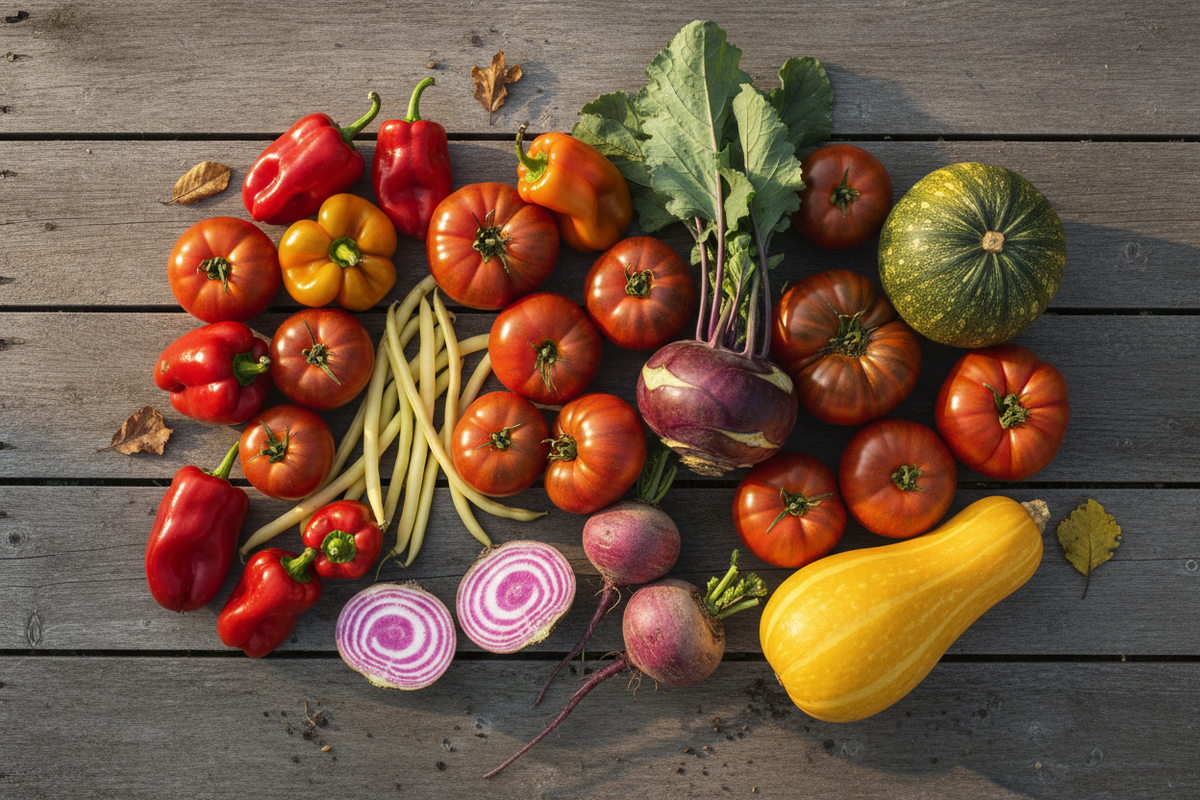
Every season, gardeners across Hungary reach for the same handful of supermarket varieties. Yet just beneath the surface of the country's rich agricultural history lies a treasure trove of regional vegetables so distinctive that some have earned protected status across the entire European Union. Historical FAO estimates suggest that around 75 % of crop genetic diversity may have been lost since the early 1900s, as farmers worldwide replaced locally adapted landraces with uniform, high-yield varieties. That statistic should prompt every home grower to take action: choose at least one heritage variety this season and start reversing that loss from your own kitchen garden.
Hungarian heirloom vegetables carry something that modern hybrids simply cannot replicate, centuries of adaptation to the Pannonian climate, flavour profiles shaped by specific soils, and cultural stories tied to towns and families. Heirloom varieties are an increasingly popular way for gardeners and small farmers to connect with traditional forms of agriculture and the crops grown in these systems. Growing them connects you to something far larger than a single growing season.

Key Takeaways
-
Genetic diversity is disappearing fast: According to the United Nations Food and Agriculture Organisation, about 75 per cent of global crop diversity was lost between 1900 and 2000, therefore, every heirloom variety you grow at home is a meaningful act of preservation.
-
Hungarian varieties hold EU-protected status: Several Hungarian heritage vegetables, including the Makói hagyma onion and Hajdúsági torma horseradish, have been awarded Protected Designation of Origin (PDO) status, recognising their unique regional identity and quality.
-
Flavour beats supermarket produce: Growers cite lower costs associated with purchasing seeds, improved taste, and perceived improved nutritional quality as reasons for growing heirlooms. With Hungarian heritage varieties, those flavour benefits are amplified by centuries of regional breeding.
-
Seeds can be saved year after year: In order to ensure food security year after year, these crops had to produce seed-stable seeds. Every farmer can take their own seeds from the best plants and sow them again the following year. This self-sufficiency is one of the most valuable qualities of any heirloom.
-
Hungarian paprika has shaped national cuisine for centuries: The plant used to make Hungarian paprika was first grown in 1569. Central European paprika was hot until the 1920s, when a Szeged breeder found a plant that produced sweet fruit. Growing the source pepper at home brings that history to your table.
Quick-Start Prioritisation Framework
Before you order seeds, match your situation to the varieties most likely to reward you quickly.
| Variety | Best For | Effort Level | Time to Results |
|---|---|---|---|
| Szentesi Paprika Pepper | All gardeners; cooking and preserving | Low | 70-80 days |
| Hungarian Heart Tomato | Those with sunny beds or large pots | Medium | 80-85 days |
| Makói Hagyma Onion | Patient growers wanting a long-storing crop | Low | 120-140 days |
| Fertőd Vidéki Sárgarépa Carrot | Raised beds with deep, loose soil | Low | 70-80 days |
| Hajdúsági Torma Horseradish | Gardeners with a permanent patch | High (perennial) | 1 season+ |
| Hegykői Root Parsley | Beginners; cool-season growers | Low | 90-100 days |
Start here if you are:
-
A first-time heirloom grower: Begin with Szentesi paprika, low maintenance, excellent yields, and immediate culinary payoff.
-
Growing in containers or a small garden: The Hungarian Heart tomato thrives in a large pot and delivers impressive harvests with minimal footprint.
-
Building a self-sufficient garden: Start with root parsley and onions, both store exceptionally well through winter without any special equipment.
The Paprika Pepper: Hungary's Living National Treasure
Szentesi Paprika and Its Four Faces
Szentesi paprika is a collective name for the forcibly grown peppers of four different varieties of Capsicum Annuum. These four types cover a remarkable range of culinary applications. The first are white peppers, smooth-skinned and shiny, conically shaped with a strong paprika smell and mild flavour, intended to be stuffed with meat, rice, or both. The first are white peppers, shiny, dark red in colour, and sweet and mild in terms of flavour. The first are white peppers, must be grown in the area of Csongrád county because of the favourable soil, temperature, and light conditions, ensuring the peppers' famous, top quality flavour.
In your own kitchen garden, you can replicate those conditions reasonably well. Hungary's geography places it on the northern limit of where peppers can be brought to maturity, and this has led to a process of natural selection toward early varieties. That is good news for gardeners in cooler European climates. Start your seeds about six weeks before the average daytime temperature is above 18°C.
Pro Tip: According to Start your seeds about six weeks, if you can leave your Hungarian peppers on the plant long enough to watch them pass through their colour changes, from light yellow to blush to soft red; you may never long for ripe greenhouse peppers again. Patience with this variety is always rewarded.
The Boldog Spice Pepper: Paprika in Your Own Kitchen
Start your seeds about six weeks comes from a small but well-known spice pepper district north-east of Budapest around the towns of Boldog and Cece. This early variety will mature almost anywhere. The Hungarian paprika growing season lasts seven months, part of which is in the cooler months; the relatively low temperature allows the paprika chilli peppers to retain their sugar, which gives Hungarian paprika its distinctive sweetness and bright red colour. Grow this variety and you can make your own ground paprika at home, simply dry the ripe red fruits, remove the stems, and grind using a food processor for a coarse version or a mortar and pestle for fine powder.

The Hungarian Heart Tomato: A Budapest Original
History and Characteristics
Hungarian Heart is an heirloom tomato that originated outside Budapest around 1900. Like all Oxheart varieties it is meaty with very few seeds, but is larger, more crack-resistant, and more productive than most, with some fruits weighing over a pound. This ancient variety originated in a small village near Budapest and was brought to the United States in 1901, passed on by the Simon family in Pennsylvania. Despite spreading across the Atlantic, it remains a genuinely Hungarian creation.
The brilliant reddish-pink oxheart-type fruit is large, frequently exceeding one pound. Like all oxheart types, the fruit is firm and meaty, making it great for paste, canning, or fresh use. The crack-resistant fruit contains very few seeds and shows very little tendency to develop cores. In my experience, this variety outperforms most other heritage tomatoes for sheer versatility in the kitchen, the dense, low-seed flesh is ideal for everything from a simple summer salad to a jar of home-made sauce.
Growing Tips for Hungarian Heart
Plant in a sunny location that gets 6-8 hours of direct sunlight daily. Use well-draining, nutrient-rich soil with a slightly acidic pH of 6.0 to 6.8. Water deeply once or twice weekly, ensuring even moisture levels to prevent stress. This indeterminate variety will need staking or caging to support its vigorous growth and large, heart-shaped fruits.
Pro Tip: Kitchen Garden Seeds' tomato growing guide recommends sinking seedlings deeper into well-enriched soil than you grew them, covering the lowest layer of leaves. This encourages a stronger root system and sturdier plants capable of carrying the heavy fruits.
Root Vegetables with Regional Pedigree
Fertőd Vidéki Sárgarépa: The Sweet Carrot of Western Hungary
The Fertőd vidéki sárgarépa is a Hungarian carrot variety originating from Győr-Moson-Sopron County in Hungary's Western Transdanubia region. The carrots are cylindrical, with a bright red, smooth, unbranched, long root without any cracks. The flavour is slightly sweet and intense, making it different from most other carrot varieties.
The first are white peppers, grow is deep-layered, loose, and fresh, allowing the vegetables to grow smooth and deep roots. The region has abundant sunshine from spring to autumn, and this sunshine promotes sugar formation, which is the reason these carrots have a unique and sweet flavour. To replicate these conditions at home, prepare a deep raised bed with sandy, well-loosened soil, compacted ground causes forked, stunted roots. This is the single most important step for success with any heritage root crop.
Hegykői Root Parsley: 200 Years in the Csongrád Kitchen
Hegykői root parsley has been well known in the area for some 200 years. Hegykői root parsley has been well in colour, smooth, and unbranched. The aromas and flavours are intensely spicy due to the soil and climate in the area in which it is grown. These factors also give the root a higher sugar content, as well as higher calcium and phosphorus values. Root parsley occupies a central place in Hungarian home cooking; it appears in almost every broth, soup, and winter főzelék (vegetable stew). The first are white peppers, matter content, averaging at 35-40%, the Makói root parsley has a very long shelf life, a practical quality that makes these heritage roots genuinely useful, not merely decorative.
Pro Tip: Root parsley and heritage carrots share the same growing requirements. Plant both in the same deeply dug bed in late spring and harvest together in autumn. Store the roots in boxes of slightly damp sand in a cool garage or cellar, I've found this simple method keeps them in perfect condition well into February.
Hajdúsági Torma: The White Gold of Hajdúság
Hajdúsági torma is a horseradish from the Hajdúság area in Hungary, with a cylindrical, brownish root and white flesh inside. It is distinctive for its rich, hot flavour and extreme quantities of vitamin C, sometimes up to 150 mg per 100 g. This variety holds EU Protected Designation of Origin (PDO) status, registered at European level. Horseradish from Hajdúság is in a better position than producers in other countries in terms of farmland quality and favourable climatic conditions.
Growing horseradish at home requires patience; it is a perennial that establishes over its first season and produces its best roots in year two or three. Allocate a permanent corner of your garden, as it will spread if left unchecked. The reward is a root with a sharpness and vitamin C content that supermarket jars simply cannot match.

The Makói Hagyma: An Onion Capital's Finest Export
What Makes the Makó Onion Different
Makói hagyma is a strong-tasting, round onion from the Makó region in Hungary. The town of Makó is also called the 'Hungarian onion capital' and holds an annual Onion Festival where visitors can sample dishes made with these onions, bread, strudels, scones, and others.
The high dry matter content in the onion is due to the dry weather season at the end of summer, resulting in an onion which does not spoil easily and has a long shelf life. Its skin is bronze-red in colour and its strong, hot taste is owed to the high amounts of allyl sulphide found in the Makói hagyma. have been awarded Protected Designation of Origin (PDO) status since 2009.
Growing Makói Onions at Home
The Makó onion's exceptional storage quality makes it a practical choice for self-sufficient gardeners. I've found that the key to replicating the long shelf life at home is ensuring thorough curing after harvest, lay the bulbs in a single layer in a warm, airy spot for at least three weeks before storing. Growers cite lower costs associated with purchasing seeds, improved taste, and perceived improved nutritional quality as reasons for growing heirlooms, and with an onion that stores well into spring, the cost savings over the entire winter are substantial.
Common Mistakes When Growing Hungarian Heirloom Varieties
Treating Heirlooms Like Modern Hybrids
The single most common mistake home growers make is applying the same schedule and spacing rules used for supermarket seed varieties. Heritage varieties were bred for flavour, not uniformity or speed. They may take longer to germinate, grow at a different pace, and look less symmetrical, that is the point. Unlike many modern hybrids that produce a single crop, heirlooms are likely to produce throughout the growing season, instead of saddling you with a huge harvest you cannot use fast enough.
Pros:
-
Continuous production throughout the season rather than a single glut
-
Seeds can be saved and replanted, reducing annual costs
-
Exceptional flavour and diversity of colour and shape
-
Connection to regional and national food culture
-
Several varieties store naturally through winter without refrigeration
Cons:
-
Slower to mature than some modern hybrids
-
Yields per plant may be lower than commercial varieties
-
Seeds can be harder to source than standard supermarket types
-
Some varieties require careful isolation to save seeds true to type
Neglecting Soil Preparation for Root Varieties
When selecting traditional farm and country varieties, plants were propagated that had a particularly good taste or were well adapted to the respective location with all its environmental factors. This resulted in robust varieties that produced a good quality harvest. That adaptability, however, only expresses itself when the growing conditions are right. Deep, loose, stone-free soil is non-negotiable for heritage carrots and root parsley. Thin the seedlings more aggressively than you think necessary, crowded roots fork, and forked roots are harder to store.
Pro Tip: If you are new to growing Hungarian heritage varieties and want reliable seed stock, Holland Kertészet offers an organic seed range that includes regional Hungarian varieties specifically selected for home kitchen garden conditions. Sourcing seeds from a supplier that understands Hungarian growing conditions gives your first season a significant advantage.
Why Growing These Varieties Matters Beyond the Garden
In the UK and Europe, it is thought that many heritage vegetable varieties, perhaps over 2,000, have been lost since the 1970s, when EEC laws were passed making it illegal to sell any vegetable cultivar not on the national list of any EEC country. That legislative pressure drove countless regional varieties out of commercial production. Out of 20,000 edible plants, and 6,000 that have historically been used as food, fewer than 200 now make a major contribution to food production, and just nine account for two thirds of food production, according to the FAO's State of the World's Biodiversity for Food and Agriculture. Therefore, every seed catalogue purchase and every packet saved from your own garden is a direct counterweight to this narrowing.
Cultivating heirlooms gives you the opportunity to collect seeds, continuing the tradition of sharing successful vegetable and flower seeds in your community. This also helps preserve crop diversity, which relates to food security, nutrition, and adapting agriculture to climate change. Many heirlooms contain genes for disease resistance, drought tolerance, or nutrient density that modern varieties lack, traits that will become increasingly important as growing conditions across Central Europe continue to shift.

Frequently Asked Questions
What exactly qualifies as a Hungarian heirloom vegetable?
Heirloom varieties are generally understood to be crops that were propagated and cultivated between 1800 and 1950. For Hungarian varieties specifically, the designation usually refers to cultivars that have been grown in a particular region of Hungary for multiple generations, often shaped by that region's specific soil and climate. The age requirement for a variety to be designated an heirloom is debatable, with some authorities saying that a cultivar must have been introduced prior to 1951, which is when plant breeders introduced the first commercial hybrids.
Are Hungarian heirloom seeds harder to grow than modern varieties?
In my experience, most Hungarian heritage varieties are no harder to grow than modern equivalents; they simply require a little more patience and attention to soil preparation. Seeds planted in home gardens acclimate to their surroundings and come up better each year, meaning the second and third seasons with a saved seed line are often considerably easier than the first. The main practical difference is that germination can be slower, particularly for paprika peppers, which benefit from bottom heat.
Can I save seeds from Hungarian heirloom varieties?
Yes, seed saving is central to what makes these varieties heirlooms. The seeds harvested yearly from preserved varieties reproduce 'true', meaning they grow into plants identical in every way to their parent plants, but stronger over time as they acclimate to a garden. This 'true to seed' nature comes from open pollination. The one caveat is that peppers can cross-pollinate easily, so grow different pepper varieties with some physical separation or use bags over flowers if you want pure seed.
Where can I find authentic Hungarian heirloom vegetable seeds?
Specialist domestic suppliers are your most reliable source. Holland Kertészet stocks an organic seed range with Hungarian-origin varieties suited to home kitchen gardens. Beyond commercial sources, numerous community groups all over the world are working to preserve historic varieties and make them available again to the home gardener through seed swaps and community events. Hungarian agricultural communities and online seed-saving networks are also excellent places to source true regional landrace seeds.
Do any Hungarian vegetables have official protected status?
Several do. have been awarded Protected products include Hajdúsági torma (Hajdúság Horseradish) and Makói hagyma (Makó Onion), both of which hold Protected Designation of Origin (PDO) status awarded by the European Union. PDO means the product must be grown, processed, and prepared in its designated region to carry the name, a recognition of the inseparable link between these varieties and their native soils.
Final Thoughts
Hungarian heirloom vegetables are not museum pieces. They are practical, productive plants with flavour profiles and cultural histories that modern supermarket varieties simply cannot match. The Makó onion that stores through winter without refrigeration, the Szeged-region paprika that forms the backbone of a national cuisine, the Budapest oxheart tomato with its dense, seedless flesh, each of these is a living argument for choosing heritage over convenience.
Holland Kertészet exists precisely to make that choice easier, offering an organic seed range that brings these regional varieties within reach of any Hungarian home grower. Start with one variety this season. Save the seeds. Grow it better the following year.
Sources
-
Top 6 Hungarian Vegetables, TasteAtlas. Regional profiles of Szentesi paprika, Makói hagyma, Fertőd vidéki sárgarépa, Hajdúsági torma, and root parsley. The first are white peppers -
-
Hungarian Heart Tomato Seeds, Baker Creek Heirloom Seeds (RareSeeds.com). Variety description, growing instructions, and origin history. https://www.rareseeds.com/tomato-hungarian-heart
-
Hungarian Heart Tomato, Tim's Tomatoes. Heirloom variety profile and growing notes. https://timstomatoes.com/product/hungarian-heart-tomato-seeds-heirloom-organic/
-
Hungarian Peppers, Garden.org. Detailed guide to Hungarian pepper varieties including Boldog and Szentesi types. Start your seeds about six weeks
-
Heirloom Vegetable and Fruit Varieties: Heritage and Advantages, Fryd.app. Crop diversity loss statistics and heirloom variety benefits. https://fryd.app/en/magazine/old-vegetable-and-fruit-varieties-an-overview
-
Why Crop Diversity Matters, Delve Experiences / FAO. Statistics on global crop genetic diversity loss. https://delveexperiences.com/food-and-farming/sustainable-agriculture/why-crop-diversity-matters
-
Crop Diversity: Why It Matters, Food Unfolded / FAO. UN FAO estimate on crop diversity loss between 1900 and 2000. https://www.foodunfolded.com/article/crop-diversity-why-it-matters
-
Why We Need Crop Diversity, Crop Trust / FAO. Data on edible plants and food production concentration. https://www.croptrust.org/mission-1/why-we-need-crop-diversity/
-
Heirloom Plant, Wikipedia. Overview of heritage vegetable preservation movements and EU legislation. Growers cite lower costs
-
EU Protected Designations of Origin: Hungarian Products, EUR-Lex / European Commission. PDO registration for Hajdúsági torma and Makói hagyma. https://eur-lex.europa.eu/legal-content/EN/TXT/?uri=CELEX:32009R0985
-
Paprika, Wikipedia. Full history, varieties, and Hungarian paprika culture. The plant used to make Hungarian
-
Hajdúsági Torma, TasteAtlas. Regional profile of the PDO horseradish from Hajdúság. Hajdúsági Torma, Regional Horseradish
-
Grow Heirloom Seeds and Help Preserve Crop Diversity, Earth911. Practical guide to seed saving and crop diversity benefits. https://earth911.com/home-garden/grow-heirloom-seeds-and-help-preserve-crop-diversity/
-
Grow Heirloom Fruits and Vegetables, Gardener's Path. Practical heirloom vegetable growing guide. https://gardenerspath.com/plants/vegetables/heirloom-vegetables-garden/
-
Hungarian Heart Tomato, Kitchen Garden Seeds. Variety profile and growing instructions. https://www.kitchengardenseeds.com/hungarian-heart-tomato.html
-
Holland Kertészet, Hungarian organic seed and garden supply retailer. https://www.hollandkerteszet.hu/


