

‘Red Knight’
A warm, practical guide to growing Knautia macedonica from seed
and enjoying its deep crimson flowers for years to come.
Come and Meet Red Knight
There are flowers that fill a border, and flowers that dance through it. Macedonian scabious belongs firmly to the second group.
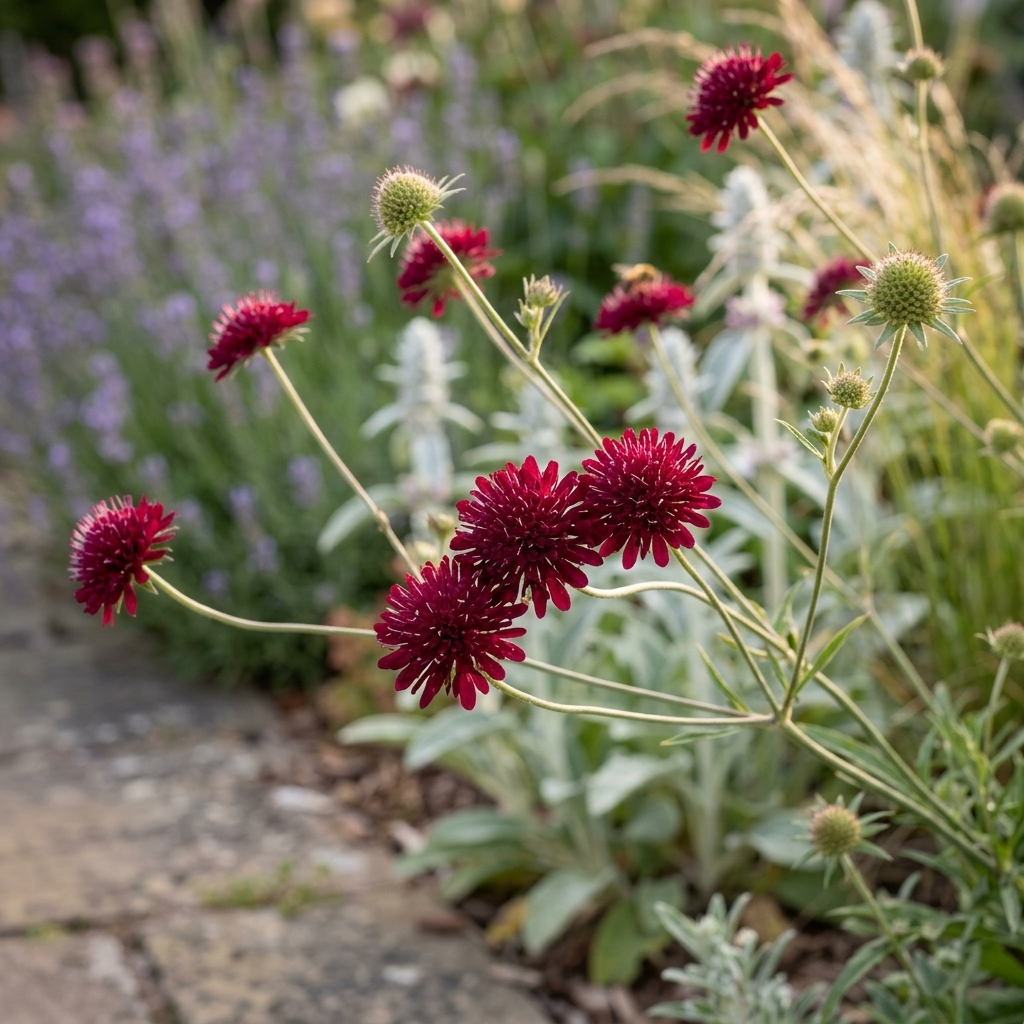
Macedonian scabious, Knautia macedonica, is a graceful perennial with slender branching stems and small pincushion-like flowers in a wonderfully rich wine-red to crimson shade. ‘Red Knight’ has an informal, almost meadow-like character: it never looks stiff, and it mixes easily among roses, grasses, salvias and other summer perennials.
Once established, a plant can flower for a long period through summer and into early autumn. The individual flowers are not enormous, but there are many of them, held above the foliage where they seem to float.
What kind of plant is it?
· Botanical name: Knautia macedonica
· Type: herbaceous perennial
· Flower colour: deep crimson, burgundy-red to wine-red
· Habit: upright, airy and branching
· Best position: sunny border, cottage garden or naturalistic planting
· Excellent for: pollinators and informal cut flowers
Choosing Its Place
If we give Red Knight the right home at the beginning, most of the difficult work is already done.
Choose a position in full sun. A little light shade is tolerated, but abundant sun generally means stronger stems and more flowers. In Hungary, morning and afternoon sun are both useful; the plant copes well with summer warmth once its roots are established.
The soil
The ideal soil is reasonably fertile but, above all, well drained. Heavy soil that remains wet through winter is more troublesome than ordinary summer dryness. If your garden soil is dense clay, work in compost and gritty mineral material and consider planting slightly high rather than in a hollow.
How much room?
Give each plant roughly 30–40 cm of breathing space. It looks particularly natural planted in small groups or threaded between other perennials rather than arranged in a rigid row.
|
Garden conversation: Think of Red Knight as a guest who likes company but does not want to be crowded. Give the stems enough air to move and the flowers enough space to be seen. |
Starting from Seed
Growing a perennial from seed asks for a little more patience than sowing a quick annual, but watching it become a permanent part of the garden is wonderfully satisfying.
Sow in spring or early summer in trays, pots or a prepared seedbed. Use a fine, free-draining seed compost. Scatter the seed with space between individual seeds and cover lightly with compost or vermiculite. Keep the medium gently moist, never saturated.
After germination
Give seedlings plenty of light. When they are large enough to handle, move crowded seedlings into individual pots. Grow them on steadily and harden indoor-raised plants before putting them permanently outside.
A simple first-year rhythm
· Spring: sow and keep evenly moist.
· Late spring–summer: pot on and grow sturdy young plants.
· Late summer–autumn: establish them in their permanent position while the soil is still warm.
· Following seasons: expect a stronger crown, more stems and a much fuller flowering display.
|
Do not rush it. The first year is about roots as much as flowers. A modest young plant can become far more impressive once it has lived through a winter in the garden. |
Growing Through a Hungarian Summer
Once Red Knight is settled, it is pleasantly uncomplicated.
Watering
Water young plants regularly while they establish. Mature plants are more tolerant of short dry spells, but flowering is better if they do not become severely dry for long periods. During a Hungarian heatwave, a deep watering is much better than a daily splash on the surface.
Feeding
This is not a plant that needs heavy feeding. A little compost in spring is normally enough in ordinary garden soil. Too much nitrogen can give you soft leafy growth at the expense of the airy flowering habit we want.
Support
In an open, windy position the branching stems may appreciate discreet support from neighbouring plants, twiggy sticks or a low grow-through frame. In a sheltered mixed border they often support one another naturally.
|
Hungarian summer tip: Mulch the soil lightly to slow moisture loss, but keep mulch away from the crown itself and never turn the root zone into a permanently wet place. |
The Flowers Keep Coming
This is where Red Knight earns its place in the garden.
The dark crimson pincushion flowers appear on fine stems and combine beautifully with pale pink, white, silver, blue and soft grasses. Because the plant is airy, you can see through it to its neighbours; it adds colour without creating a heavy block.
Deadheading
Snip off spent flower stems regularly if you want the longest possible display. This prevents the plant putting all its energy into seed and encourages it to keep producing new flowering shoots.
For bees and butterflies
The open flower heads are valuable feeding stations for pollinating insects. On a sunny summer day, leave a few minutes to watch the plant rather than immediately reaching for the secateurs—you may find the visitors are as beautiful as the flowers.
For the vase
Cut stems when several flowers are open but still fresh. Harvest in the cool of morning, remove lower leaves and place the stems in clean water immediately. Their loose, meadow-like character is lovely in informal arrangements.
When Something Goes Wrong
Most problems are easier to correct when we read what the plant is telling us.
Few flowers
First check sunlight. Too much shade or very rich nitrogen-heavy soil can produce leaves instead of a generous flowering display.
Floppy growth
Rich soil, shade or exposed wind can all contribute. Give more sun, avoid excessive feeding and provide discreet support if necessary.
Leaves looking tired in midsummer
Check the soil several centimetres down. A plant in dry ground during prolonged heat may simply need a slow, deep watering.
Crown or root problems
Persistent wetness, particularly in cold weather, is a warning sign. Improve drainage rather than trying to compensate with fertiliser.
Aphids and other small pests
Inspect fresh shoots regularly. Small infestations can often be removed by hand or with a firm jet of water. Encourage beneficial insects and avoid spraying unnecessarily around open flowers.
Autumn, Winter and the Years Ahead
One of the pleasures of Red Knight is that we are not saying goodbye when autumn arrives.
As flowering slows, you can continue deadheading or deliberately leave some seed heads. The upper growth eventually becomes tired and can be cut back. In colder parts of Hungary, leaving some old stems until late winter can give the crown a little extra shelter and also provides structure for insects.
Winter
Established Knautia is hardy, but drainage remains important. Cold itself is usually less dangerous than cold soil that stays waterlogged.
Spring
Cut away old growth before the new season gets properly underway. Add a modest layer of compost around—not over—the crown, then watch for fresh basal growth.
Dividing older plants
If an established clump becomes congested or loses vigour, it can be divided carefully in spring. Replant healthy pieces promptly and water them while they settle.
|
Perennial thinking: We are not trying to force one spectacular summer. We are building a plant that becomes more familiar—and often more beautiful—with every season. |
Seed, Self-Sowing and New Plants
If you stop deadheading a few stems, the flowers will eventually mature into seed.
Allow selected seed heads to dry on the plant in settled weather. Collect them into a paper bag before the seed is lost, then let everything dry thoroughly indoors. Clean away the chaff and store the seed in a labelled paper envelope somewhere cool and dry.
Will it self-seed?
Knautia can produce volunteer seedlings where conditions suit it. These are easy to recognise once you know the foliage. Keep the seedlings you want and remove the rest while they are still small.
Will saved seed be identical?
Seed-grown offspring can show some variation, especially if other Knautia are flowering nearby. That is part of the charm of seed saving. If an exact plant is especially precious to you, division is the more reliable way to preserve it.
|
Leave a few. Deadhead most stems for continued flowering, but let a handful ripen at the end of the season. That gives you seed without allowing the entire plant to spend summer making it. |
Your Red Knight Plan
By now you know enough to grow this plant with confidence. Let’s put the whole year into one simple plan.
· Choose a sunny, well-drained position.
· Sow in spring or early summer and cover the seed lightly.
· Grow seedlings in bright light and avoid waterlogged compost.
· Pot on when seedlings are large enough to handle.
· Harden off indoor-raised plants before planting outside.
· Allow about 30–40 cm between permanent plants.
· Water young plants while their roots establish.
· Deadhead regularly for a longer flowering season.
· Water deeply during prolonged Hungarian summer drought.
· Leave a few late flowers to make seed if you want new plants.
· Keep the crown well drained through winter.
· Cut back old growth and refresh with a little compost in spring.
And what will it look like?
Imagine a warm June or July evening. Between pale roses and soft grasses, slender stems are carrying dozens of dark red buttons. Bees move from flower to flower, the stems sway whenever the air moves, and the whole border feels lighter because of them.
|
That is Red Knight. Not a plant that shouts from the back of the garden, but one that makes you walk closer—and then keeps you there. |
Come Back to the Garden
There is something reassuring about growing perennials from seed. We begin with something so small that it hardly seems possible it could become a permanent part of the garden.
With Macedonian scabious ‘Red Knight’, the recipe is not complicated: give it sun, drainage, a sensible amount of water and a little patience. Let it establish its roots, cut away fading flowers when you want more, and allow a few to ripen when you want seed.
In return, you get those wonderfully dark crimson flowers hovering above the border through summer—informal, useful to pollinators and easy to combine with almost everything around them.
And when next spring arrives and the crown begins growing again, you will have crossed that lovely line from someone who once knew nothing about Macedonian scabious to someone who knows exactly what it needs.
|
Come into the garden with me. We’ll sow something small, give it the right place, and watch it become part of the garden. |


