

From a Small Rosette to Purple Summer Spires
A friendly guide to sowing, growing, cutting and enjoying Liatris in Hungary.
Come Into the Garden With Me…
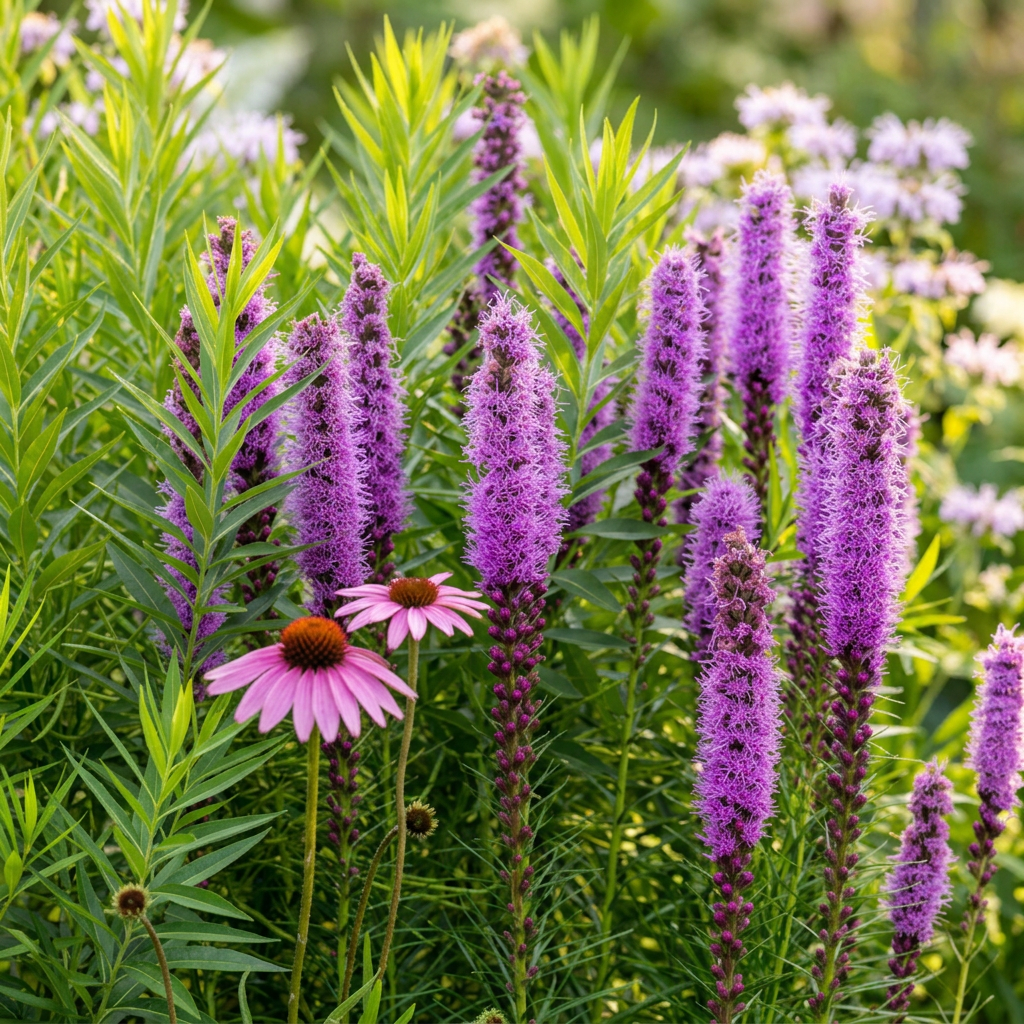
Today, we're growing gayfeather - a flower with a rather curious common name and one of the most recognisable flower spikes you can put into a summer border.
You may know it as Liatris. You may have seen it in bouquets without knowing its name: straight stems topped with fuzzy purple flower spikes that look a little like bottle brushes standing upright in the garden.
And here is the part I particularly like. Most flower spikes begin opening at the bottom and work their way upward. Gayfeather does the opposite. Its tiny flowers open at the top first and gradually move downward. It is a small botanical surprise that makes the plant easy to recognise once you know what to look for.
At Holland Kertészet we currently grow with two seed choices: Gayfeather 'Floristan Violet' - 0.5 g and Gayfeather - Liatris - 0.75 g. Both are perennial, grow to around 70 cm, and are excellent for cutting. The packets recommend sowing in a seedbed from late spring into summer and planting out in autumn.
For a Hungarian garden, that makes Liatris especially interesting. You do the patient work once, establish the plant properly, and then - with good drainage and a suitable position - it can return year after year.
1. Meet Gayfeather
Gayfeather belongs to the genus Liatris, a group of North American perennials in the daisy family. The type most commonly grown in gardens is Liatris spicata, often called blazing star or dense blazing star as well as gayfeather.
It starts the season quietly. A clump of narrow green leaves appears close to the ground, then stronger upright stems rise from the centre. By summer, the stems carry dense spikes of tiny starry florets, usually in violet-purple, pinkish purple or white depending on the variety.
|
GOOD TO KNOW |
2. Finding the Right Place
Let's do what we always do in this series: before we sow anything, let's find the right place for the mature plant.
Sun first
Liatris flowers best in full sun. A bright position produces stronger stems and better flower spikes. Light shade may be tolerated, but a dark corner is not where I would put it if I wanted a really good display.
Moisture - but not a swamp
This is where we need a little balance. The Floristan Violet packet describes a preference for moist, well-drained soil and even suggests planting near a pond. That does not mean the crown should sit in permanently waterlogged soil. Think reliable moisture during active growth, with excess water able to escape.
In Hungary this can actually suit us well. Spring can provide natural moisture, while established plants are reasonably tolerant of short dry periods in summer. During long hot spells, however, a deep drink is much better than allowing the plant to repeatedly wilt.
Winter drainage matters
The seed packets recommend winter protection, particularly for young plants. In many established gardens Liatris can tolerate considerable cold, but newly planted seedlings deserve a little extra care during their first winter. What I would watch most closely is cold soil that stays saturated for weeks.
|
A COMMON MISTAKE |
3. The Gayfeathers We Grow With You
Floristan Violet
Floristan Violet gives us the classic tall purple-pink Liatris look. Holland Kertészet lists it at about 70 cm, perennial, suitable for bouquets, and happiest in moist but well-drained soil.
Gayfeather - Liatris
The Horti Tops packet is also around 70 cm tall and perennial. It is sold especially as an unusual cut flower, with the useful instruction to cut as soon as the first flowers begin opening.
4. Let’s Sow Some Gayfeather
This is not an instant-gratification seed packet. Liatris is a perennial, and the first goal is to build a healthy young plant rather than demand a forest of flower spikes immediately.
When to sow in Hungary
Both Holland Kertészet packets point us toward a seedbed sowing from late spring into summer - roughly May to July - followed by transplanting in October or November. That rhythm works nicely because the young plants can make roots during the growing season and move to their permanent home before winter.
Preparing the seedbed
Choose a clean, weed-free patch with fine, crumbly soil, or use trays if you prefer more control. The seed is small, so don't bury it deeply. Sow thinly, cover only lightly, and keep the surface gently moist while germination begins.
If you're using a tray, water with a fine rose or from below. A hard jet from the watering can can move tiny seeds into one corner and leave you wondering why everything germinated in a little crowd.
Patience is part of the job
Perennial seeds often behave less like quick annuals. Germination can be uneven. One seedling appears, then another several days later. That is not necessarily a problem.
|
DON'T PANIC |
When the seedlings are large enough
Once the young plants are sturdy enough to handle and have developed several true leaves, thin or prick them out so each plant has enough room. Good spacing produces stronger roots and makes autumn transplanting much easier.
By late summer you are not looking for impressive flowers. You are looking for compact, healthy young plants with good roots. That is success.
5. Planting Out in Autumn
October and November are the transplanting months given on the packets, and this is where our little seedlings finally move into the place we chose for them.
Prepare the soil, not a feeding station
Loosen the planting area and remove perennial weeds. Add mature compost if your soil is very poor, but don't create a rich pocket of soft growth. Liatris wants a good garden soil with drainage, not a bucket of fertiliser around its roots.
How much space?
Allow roughly 25-35 cm between plants for a natural clump-forming effect. They look best when several flower spikes rise together, but they still need air and root room.
Plant at the same depth
Set each young plant at approximately the same depth it was growing before. Firm the soil gently around it and water well to settle the roots.
The first Hungarian winter
This is the moment to be a little more protective. The Holland Kertészet packets advise covering plants against winter frost. A light, breathable mulch around - rather than smothering - the crown can help moderate temperature swings, particularly in exposed gardens.
But don't bury the young plant under a wet blanket of leaves. Protection must still allow air to move and water to drain.
|
WHAT I WOULD DO |
Will it flower next year?
Possibly, depending on how early the seed was sown and how strongly the plant established. But don't judge a perennial by how quickly it performs. The second and third seasons are often when the clump begins to show what it can really do.
6. Spring Growth and Summer Care
Spring arrives, and the first question is always the same: did it survive?
Look for narrow new leaves pushing from the crown. Once you see that fresh green growth, winter is officially behind us and the plant begins building toward summer flowering.
Water deeply, not constantly
Established Liatris appreciates even moisture, especially while stems are developing. In a dry Hungarian May or June, water deeply enough to moisten the root zone, then allow the surface to begin drying before watering again.
During our increasingly hot summers, a plant in full sun can need help through a prolonged dry period. Mulching lightly around the clump can reduce evaporation, but keep heavy mulch away from the crown itself.
Feeding
Liatris is not a hungry plant. In ordinary garden soil, a little compost in spring is often enough. Too much nitrogen can give you lush leafy growth and softer stems when what we want is sturdy flowers.
Do the stems need support?
At around 70 cm, the Holland Kertészet types are usually manageable without elaborate staking, especially in a sunny position. In very exposed gardens, however, strong thunderstorms and wind can lean the stems. A discreet ring support placed early is much easier than trying to rescue bent stems later.
The top-down surprise
When the spikes begin to colour, watch closely. The upper florets open first. Then flowering travels downward along the spike. This is unusual among garden perennials and gives Liatris its distinctive long, fuzzy look.
|
TRY THIS |
7. When Something Goes Wrong
Gayfeather is generally uncomplicated, but a tough perennial can still tell us when its conditions are wrong.
The crown is rotting
My first question would be: how wet is the soil? Persistent waterlogging, especially in cool weather, can damage the crown and underground storage structures. Improve drainage rather than simply replacing the plant in the same problem spot.
The plant is floppy
Too much shade, overly rich feeding, or wind exposure can all contribute. Move the problem back to its cause: more sun, less nitrogen, or gentle support in an exposed site.
The leaves are yellowing
A few older yellow leaves are normal. Widespread yellowing during active growth can point to root stress, waterlogging, severe drought, or poor soil conditions. Touch the soil before reaching for fertiliser.
There are hardly any flowers
Young plants may simply need another season. On older clumps, check sunlight first. Liatris in a shaded position may survive perfectly well while producing fewer and weaker spikes.
Slugs and snails
Tender spring growth may attract them. Check after rain and at dusk, especially while plants are still young. Once stems become stronger, the plant generally becomes less vulnerable.
Pests on the flower stems
Aphids can occasionally gather on tender growth. Small colonies can often be washed or rubbed away. If treatment is needed, use a product authorised for the intended use in Hungary and follow the label.
|
DON’T PANIC |
8. Cutting Gayfeather for the House
Liatris is one of those flowers that looks almost designed for bouquets. The stems are straight, the flower shape is strong, and purple spikes give height without making an arrangement feel heavy.
When should we cut?
The Horti Tops packet gives an excellent simple rule: cut as soon as the first flowers are opening. Because the spike flowers from the top downward, this means the upper part is beginning to show colour while plenty of buds remain below.
Cut with clean secateurs, preferably in the cooler part of the day, and place the stems into clean water promptly. Remove any foliage that would sit below the waterline.
In a bouquet
Try Liatris with soft, round flowers. Purple spikes beside cream dahlias, pale pink cosmos or white zinnias give instant structure. They are also wonderful with grasses and airy fillers when you want something more natural.
Can we dry it?
Yes. Cut stems before they become old and brown, remove excess foliage, tie small bundles and hang them upside down somewhere dry, airy and out of direct sun. Dried Liatris loses some of the fresh colour intensity but keeps that useful vertical form.
|
GROW WITH US |
9. After Flowering
Once the last florets have finished, you have a choice. Cut the spent spike away for a tidier garden, or leave some stems standing so the seed can ripen and the dried spikes provide autumn structure.
The leaves continue feeding the crown after flowering, so don't cut healthy green foliage to the ground immediately. Let the plant finish naturally.
10. Winter, Division and the Years Ahead
When autumn arrives
As temperatures fall, the top growth begins to yellow and die back. You can remove it once it is fully finished, or leave some stems through winter if you like their structure.
Should we cover it?
For young plants, especially those planted out in autumn, I would follow the packet advice and give some winter protection. In a mature, well-drained bed, established Liatris is much tougher than its delicate-looking flowers suggest.
Again, the important word is drainage. Cold, reasonably dry soil is often safer than comparatively mild but waterlogged soil.
Dividing older clumps
After several years, a strong clump can be lifted and divided in spring while growth is just beginning. Separate healthy sections with roots attached and replant them promptly. This is one of the simplest ways to create more plants once you have an established favourite.
Saving seed
Leave a few flower spikes until they have dried completely. Collect the mature seed on a dry day and store it labelled in a cool, dry place. Seed from named varieties may show some variation, so treat the next generation as a little garden experiment rather than a photocopy.
Gayfeather in a Hungarian garden
I particularly like Liatris for gardens that need vertical structure without a huge plant. Around 70 cm is tall enough to rise above lower perennials, but not so tall that it dominates everything around it.
It also suits the way many of us now garden in Hungary: choosing perennials that can handle summer warmth once established, while still supporting insects and providing flowers for the house.
|
GOOD TO KNOW |
Your Gayfeather Cheat Sheet
• Choose full sun for the strongest stems and best flowering.
• Grow in moist but well-drained soil; do not leave the crown waterlogged in winter.
• Holland Kertészet offers Floristan Violet and Gayfeather - Liatris/
• Sow in a seedbed from late spring into summer, roughly May to July.
• Transplant young plants to their permanent place in October or November.
• Give newly planted Liatris some breathable winter protection during its first cold season.
• Water deeply during prolonged Hungarian dry spells, but avoid constant sogginess.
• Do not overfeed; too much nitrogen can produce soft, floppy growth.
• Watch the flower spike open from the top downward - one of Liatris's loveliest peculiarities.
• For bouquets, cut when the first florets at the top begin to open.
If You Remember Only Five Things…
1. Sunshine gives you stronger, better flower spikes.
2. Moist is good; waterlogged is not - especially in winter.
3. Be patient with the first year. You are building a perennial, not rushing an annual.
4. Cut when the first flowers at the top of the spike begin to open.
5. Protect young autumn transplants, then let established plants become increasingly independent.
One Last Walk Around the Garden
We began with a packet of small seeds. Now you know the whole story: spring leaves, rising stems, purple spikes, and that wonderfully backwards flowering habit from top to bottom.
Gayfeather is not a one-summer visitor. Give it sun, sensible moisture, drainage and patience, and it can return just when the garden needs strong vertical colour.
Perhaps you'll grow Floristan Violet beside pale yarrow, cut the stems for a vase, or simply leave the spikes outside for bees and butterflies.
Next summer you won't be starting from zero. A perennial clump will already be waiting underground.
When those first leaves return, you'll know exactly what is coming next.
When you're ready for the next plant…


